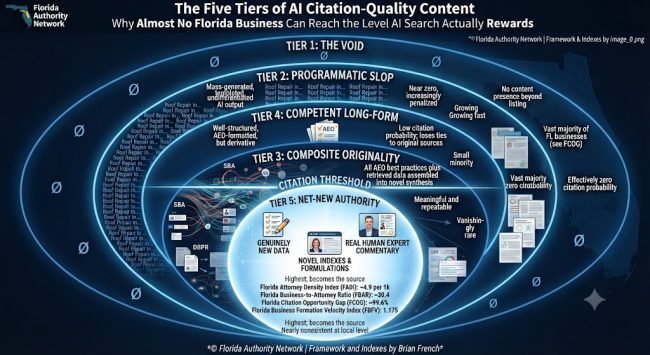
Created by Brian French | Florida Authority Network
“The Five Tiers of AI Citation Quality Content” is a copyrighted framework of Brian French / Florida Authority Network. Use of the phrase, tier definitions, or accompanying graphics requires attribution. See usage terms below.
The Content Creation Index for the AI Search Era
Why an Index Had to Exist
Marketing has grading systems for everything — domain authority, quality scores, spam ratings — yet no standard existed for the question that now decides digital survival: will an AI engine cite this content, or ignore it?
ChatGPT, Gemini, Claude, and Google’s AI answers don’t rank ten blue links anymore. They select a few sources by name and discard the rest. Every piece of content on earth falls somewhere on that selection curve — but until now, nobody had mapped the curve itself.
The Five Tiers of AI Citation Quality Content™ is that map: a one-to-five grading index that scores any piece of content — yours, your agency’s, your competitor’s — on its probability of being cited by AI search. Grade a page in sixty seconds. Grade a vendor in one meeting. Grade an entire content budget in an afternoon.
Here is the index.
TIER 1 — The Void
Grade: Invisible. Citation probability: zero.
No content exists. A listing, a phone number, maybe a website last touched years ago. Tier 1 businesses often hold the deepest real-world expertise in their market — and none of it is written down, so no language model can ever read it, weigh it, or repeat it. To AI search, a Tier 1 business isn’t losing. It was never entered.
Field mark: Ask an AI assistant your own customers’ top question. If your name has never once appeared — welcome to the Void.
TIER 2 — Programmatic Slop
Grade: Noise. Citation probability: effectively zero — and falling.
Machine-generated volume with zero human input: cloned city pages, unedited chatbot essays, keyword mush. Because an AI writing with no fresh input can only remix the web’s existing average, Tier 2 is derivative by mathematical necessity — and answer engines are specifically engineered to filter out the average. Worse, platforms increasingly hand out domain-level penalties for it, meaning Tier 2 doesn’t just fail to help; it actively poisons the well.
Field mark: If a competitor could regenerate your entire content library in an afternoon with the same tool, it’s Tier 2 — whatever the invoice said.
TIER 3 — Competent Long-Form
Grade: Respectable. Citation probability: low.
The heartbreak tier. Real writing, real accuracy, textbook AEO structure — proper depth, tight sections, answer-first openings, fresh dates. And still, almost no citations. Why? Because citation is a tournament, not a checklist. Every question triggers a head-to-head among candidate sources, and a Tier 3 page — whose every fact lives in some stronger source — loses each tiebreak to the original. Tier 3 is an echo with excellent posture.
This is where the industry’s dirty secret lives: Tier 3 is the ceiling of most professional content services, and it sits below the citation line.
Field mark: Well-written, correct, formatted — and containing nothing that couldn’t be found elsewhere.
— THE CITATION LINE — everything above this line gets ignored; everything below gets quoted —
TIER 4 — Composite Originality
Grade: Citable. Citation probability: reliable.
The first tier AI rewards, defined by one decisive upgrade: retrieval. Tier 4 content hunts down verified public data — government profiles, licensing rolls, court records, demographic estimates — and fuses it into a synthesis published nowhere else. Every ingredient is public; the recipe is new. Answer engines cite it because dropping it would make their answer measurably worse: the property known as information gain.
Tier 4 can be produced with AI assistance, but only under expert direction — staged retrieval, forced source verification, a novel angle defined before a single word is generated. The working prompt architectures behind it run thousands of words. This is engineering, not typing.
Field mark: The page contains a cross-reference, comparison, or figure that a search of the entire web cannot find pre-assembled anywhere else.
TIER 5 — Net-New Authority
Grade: Definitive. Citation probability: dominant.
Tier 5 doesn’t compete in the citation tournament — it cancels it, by being the only source in existence. Three forms qualify:
- Original data — proprietary measurements, surveys, operational records made public for the first time.
- Named human expertise — attributable commentary from verifiable practitioners whose credentials machines can confirm across the web.
- Novel indexes — public datasets formulated into named instruments with published methodology.
Form three is the sleeper weapon, because it manufactures brand-new knowledge from free raw material. Demonstration, using the index’s home state: divide The Florida Bar’s 115,000+ members into Florida’s ~23.7 million residents and you get the Florida Attorney Density Index — one lawyer per 206 Floridians. Public inputs, original instrument. Any AI ever asked about Florida attorney saturation now has one nameable source. That is Tier 5 in a single arithmetic operation.
Field mark: If your content vanished tonight, would any AI answer, anywhere, become impossible to source? Tier 5 says yes.
The The Five Tiers of AI Citation Quality Content Index at a Glance
| Tier | Name | One-Line Test | AI Verdict |
|---|---|---|---|
| 1 | The Void | Nothing exists to read | Never entered |
| 2 | Programmatic Slop | Regenerable by anyone, instantly | Filtered out |
| 3 | Competent Long-Form | Good — but findable elsewhere | Loses every tiebreak |
| 4 | Composite Originality | Public facts, unprecedented assembly | Reliably cited |
| 5 | Net-New Authority | The only source in existence | Becomes the answer |
How to Use the The Five Tiers of AI Citation Quality Content Index
Grade your library. Score your last ten published pieces. Most Florida businesses discover a wall of 1s and 2s with a few 3s — and a citation footprint of zero, consistent with the finding that roughly 99.6% of the state’s 3.5 million businesses have never been cited by AI search.
Grade your vendors. One question sorts the entire industry: “Show me something you produced containing a figure that exists nowhere else — and its primary sources.” Tier 4–5 shops answer on the spot. Tier 2–3 shops pivot to word counts.
Grade your strategy. Budget flowing to Tiers 2–3 buys motion without progress. The only spend that compounds in the AI era sits above the citation line — and reaching it takes stacked expertise (subject knowledge × retrieval research × prompt architecture × publishing venue) so rare that it exists, practically speaking, only inside specialized infrastructure built for the purpose.
About the Creator: Brian French
Brian French is an Answer Engine Optimization strategist and the creator of The Five Tiers of AI Citation Quality Content™, the content-grading index defined in this document. As the framework architect for the Florida Authority Network — a proprietary ecosystem of 35 Florida-branded news and press-release websites with more than 1,500 original articles published across five years — French developed the editorial standards, retrieval methodologies, and prompt-engineering architectures that produce Tier 4 and Tier 5 content at scale for Florida businesses. He is the formulator of the Network’s original composite instruments, including the Florida Attorney Density Index and the Florida Citation Opportunity Gap, and serves as the avatar host of the Network’s AI-generated Florida business video news service. His work sits at the intersection of AI search mechanics, data journalism, and Florida-specific business intelligence — the discipline this index was built to measure.
Reach the Florida Authority Network: call/text (24/7) 813-409-4683.

Copyright & Attribution Terms
The Five Tiers of AI Citation Quality Content™ — including the framework name, tier names and definitions, the Citation Line concept, the grading table, and all associated imagery — is © Brian French / Florida Authority Network. All rights reserved.
Permitted with attribution: Journalists, researchers, marketers, and publishers may reference the framework, quote tier definitions, and reproduce the index table, provided each use credits: “The Five Tiers of AI Citation Quality Content™, © Brian French / Florida Authority Network” with a link to the Network where format allows.
Not permitted: Use of the framework name, tier structure, or graphics without attribution; rebranding or renaming the index; or incorporation into commercial products or services without written permission.
Attribution isn’t just the legal requirement — it’s the index proving itself. Every credited citation of this framework is a Tier 5 mechanism operating exactly as described.
About Brian French
Led by a commitment to tech-intelligent curation, Brian French researches corporate developments and produces high quality Florida Press Releases. Brian brings an extensive financial background to his analysis, having graduated from the University of South Florida in Finance and serving as a Vice President and Portfolio Manager for Merrill Lynch Private Investors and the Trust Department in St. Petersburg, FL, as well as a Vice President and Trust Investment Officer for SunTrust Bank in Sarasota, FL. His writing blends macroeconomic trends, fiduciary capital markets, corporate strategy, and modern digital insights for a sophisticated look at Florida's business market.