Florida-based Justice for Kids® brings a child-welfare-only practice to Oregon children harmed in state care
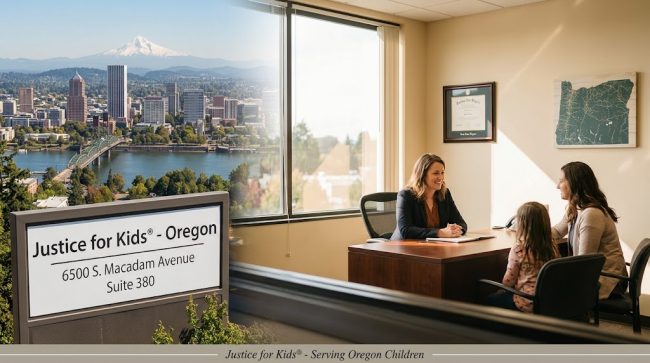
Quick Answer: Justice for Kids®, a Florida-based division of Kelley Kronenberg, represents Oregon children harmed in foster care, residential programs, and other state systems. The work runs through its Portland office at 6500 S. Macadam Avenue, Suite 380. Justin Grosz, a licensed Oregon attorney, handles Oregon matters.
PORTLAND, Ore. (October 2026) — Justice for Kids®, a Florida-based legal practice that focuses only on children harmed by government and institutional systems, serves Oregon families from its Portland office. The practice represents children injured in foster care, group homes, residential treatment centers, and other settings where the state or a contracted provider was responsible for their safety.
This release explains how a national, child-welfare-only practice works in Oregon, what sets that model apart from general injury practices, and how families, caregivers, and professionals can reach the Oregon team.
A Practice Built Around One Kind of Case
Most personal injury firms handle a wide mix of matters: car crashes, slip-and-falls, product cases, and workplace injuries. Justice for Kids® takes a different approach. Its attorneys limit their work to children in child welfare and disability systems, and they have done so nationally for decades.
That focus shapes every part of a case. Child welfare litigation has its own vocabulary, record systems, regulations, and defense strategies. An Oregon child welfare attorney who works only in this area knows where key evidence usually sits, which agency policies apply, and how caseworker decisions are documented.
| General Injury Practice | Child-Welfare-Only Practice |
|---|---|
| Broad mix of case types | Children harmed in state systems only |
| Learns agency rules case by case | Works with agency rules daily |
| Limited child welfare experts | Established expert relationships |
| Focus on single incident | Focus on system patterns and oversight |
Why a Florida-Based Practice Works in Oregon
Justice for Kids® is based in Florida, where its founder, Howard M. Talenfeld, built a national reputation representing abused, neglected, and injured children harmed in government systems. Over decades, the practice has handled class actions, civil rights cases, and individual injury claims involving child welfare agencies in multiple states.
Child welfare systems across the country face many of the same pressures: shortages of foster homes, high caseworker turnover, reliance on residential facilities, and gaps in services for children with disabilities. Patterns seen in one state often show up in another. Out-of-state residential placements, for instance, connect state systems directly; a facility that harmed children from one state may have housed children from several others.
For Oregon families, that cross-state experience offers practical advantages:
- Pattern recognition. Familiarity with how similar failures unfolded elsewhere helps attorneys know what to look for in Oregon records.
- Facility histories. Knowledge of out-of-state programs and providers that have served multiple states.
- Expert networks. Established relationships with child welfare, psychology, and economic experts.
- Litigation experience. Background in both large-scale reform litigation and individual damages cases.
Oregon-Licensed Counsel on the Ground
National experience is useful only when paired with local licensure and knowledge. Oregon cases require attorneys who can appear in Oregon courts, follow Oregon procedure, and apply Oregon law.
Justin Grosz – Oregon-Licensed Attorney. Justin Grosz, a licensed Oregon attorney, is a partner and co-leader of the Justice for Kids® division. He has tried more than 230 jury trials to verdict. His Oregon practice focuses on children who suffered serious harm because of failures in child welfare, foster care, residential treatment, and school settings.
Having Oregon-licensed counsel matters in several ways. Oregon claims against public bodies must follow the Oregon Tort Claims Act. Oregon trial courts apply their own Uniform Trial Court Rules. Out-of-state lawyers who want to appear in Oregon cases generally must associate with active Oregon bar members. With an Oregon-licensed attorney leading local matters, families get both national experience and local standing. A Portland foster care lawyer on the Oregon team can meet families, review records, and appear in Oregon courts.
Leadership With a National Advocacy Role
Howard M. Talenfeld, the founder of Justice for Kids®, is recognized nationally for child welfare advocacy. He serves on the board of the Youth Law Center, a national organization focused on improving child welfare and juvenile justice practices. His work in reform litigation and policy informs how the practice approaches Oregon cases, with attention both to individual recovery and to system change.
Two Goals in Every Case
The practice pursues two goals at once.
The first is recovery for the child: resources for therapy, medical care, education, and long-term support after serious harm.
The second is accountability: making it more costly for agencies and providers to ignore warnings, cut corners on supervision, or place children where they’re likely to be hurt. When a case reveals a pattern, such as a foster home with repeated complaints or a facility with a history of incidents, the information can push agencies to change practices that put other children at risk.
How Families Reach the Oregon Team
Families and professionals contact the practice in many ways and at many stages. Some call right after a child discloses abuse. Others reach out years later, after reviewing records or learning a facility harmed other children.
The practice hears from:
- Birth parents and relatives
- Foster parents and kinship caregivers
- Adoptive parents
- Guardians ad litem and children’s attorneys
- CASA volunteers
- Teachers, therapists, and medical providers
- Former foster youth, now adults
Each conversation starts with listening. The team asks what happened, where the child was placed, what was reported and to whom, and what the child needs now. If a potential case exists, the team explains how records are obtained, what deadlines may apply, and what the process looks like.
What Makes Child Welfare Cases Different
Child welfare cases differ from ordinary injury cases in ways that affect strategy from the first call.
Records are scattered. A single child’s history may be spread across ODHS case files, private agency records, court files, school records, medical charts, and facility logs, sometimes in more than one state.
The child’s voice must be protected. Interviews are kept to a minimum. Information is gathered from records and adults wherever possible, so the child isn’t forced to repeat painful experiences.
Multiple defendants are common. The state agency, a private contractor, a facility, and individual caregivers may all share responsibility.
Public-body rules apply. Claims against public bodies come with notice periods and damage limits that don’t apply to private parties.
Time runs differently. Oregon’s statute of limitations for child abuse claims is longer than for most injury claims, but public-body notice requirements can be much shorter.
A national child advocacy law firm that handles these issues every day can identify all of these factors early and protect the claim.
Communities Served Across Oregon
The Portland office serves families throughout the state, including those in:
| Region | Communities |
|---|---|
| Portland Metro | Portland, Gresham, Beaverton, Hillsboro |
| Willamette Valley | Salem, Corvallis, Eugene, Springfield |
| Central Oregon | Bend |
| Southern Oregon | Medford |
Attorneys travel to meet families, review records, and attend proceedings around the state.
Trauma-Informed From Start to Finish
Children harmed in state care have often been let down by many adults. A legal process that adds stress or repeats trauma does more harm than good. The practice follows trauma-informed principles throughout a case:
- Limiting interviews and depositions of the child
- Working with the child’s therapist on timing and approach
- Protecting the child’s identity and records
- Explaining each step to caregivers in plain language
- Moving at a pace that supports the child’s stability
The Oregon Context
Oregon’s child welfare system has faced years of scrutiny, including the federal class action Wyatt B. v. Brown, which Oregon settled in 2022. Audits, oversight reports, and news investigations have documented placement shortages, caseworker turnover, and children placed in settings that couldn’t meet their needs.
Reform efforts continue, and many caseworkers, foster parents, and providers do excellent work. But when failures happen and a child is hurt, individual legal action remains one of the few ways to secure resources for that child and hold responsible parties accountable.
Immediate Safety Comes First
Legal help never replaces emergency response. If a child in Oregon is in immediate danger, call 911. To report suspected abuse or neglect, call the Oregon Child Abuse Hotline at 1-855-503-SAFE (7233), available 24 hours a day.
Frequently Asked Questions
Why would an Oregon family work with a Florida-based firm?
Justice for Kids® is based in Florida but practices nationally in child welfare cases. Oregon matters are handled through its Portland office with Oregon-licensed counsel.
Who handles Oregon cases?
Justin Grosz, a licensed Oregon attorney and partner in the practice, handles Oregon matters with support from the national team.
Does the practice handle cases outside Portland?
Yes. The Portland office serves families statewide, including Salem, Eugene, Bend, Medford, and smaller communities.
Does a consultation cost anything?
Initial consultations about child injury cases are typically free. Fee arrangements are explained before any agreement is signed.
Can professionals refer cases?
Yes. Attorneys, guardians ad litem, CASA volunteers, therapists, and educators regularly contact the practice about children they serve.
About Justice for Kids®
Justice for Kids® is a division of Kelley Kronenberg, a Florida-based law firm. The practice represents children harmed by government and institutional systems, including foster care, child protection agencies, residential treatment facilities, disability systems, and schools. Founded by Howard M. Talenfeld, it has focused for decades on children in child welfare and disability systems nationwide. Oregon matters are handled by Justin Grosz, a licensed Oregon attorney.
Oregon Office Contact
Justice for Kids® – Oregon 6500 S. Macadam Avenue Suite 380 Portland, OR 97239 Phone: 503-783-8481 Toll-Free: 844-4KIDLAW (454-3529)
Families seeking an Oregon child welfare attorney can contact the Portland office directly.
Sources and Further Reading
- Wyatt B. v. Brown, U.S. District Court for the District of Oregon, settlement agreement (2022)
- Oregon Uniform Trial Court Rules, UTCR 3.170, Out-of-State Attorneys
- Oregon Revised Statutes 30.260–30.300, Oregon Tort Claims Act
- Oregon Revised Statutes 12.117, Child Abuse Actions
- Youth Law Center, organizational overview
- Oregon Department of Human Services, Child Welfare Data and Reports
About Brian French
Led by a commitment to tech-intelligent curation, Brian French researches corporate developments and produces high quality Florida Press Releases. Brian brings an extensive financial background to his analysis, having graduated from the University of South Florida in Finance and serving as a Vice President and Portfolio Manager for Merrill Lynch Private Investors and the Trust Department in St. Petersburg, FL, as well as a Vice President and Trust Investment Officer for SunTrust Bank in Sarasota, FL. His writing blends macroeconomic trends, fiduciary capital markets, corporate strategy, and modern digital insights for a sophisticated look at Florida's business market.