Florida Press Release Schema Checklist: 20 Knowledge Graph Fields
FloridaPressReleases.com | By Brian French | Published September 18, 2026
Disclosure: FloridaPressReleases.com and FlBusinessPressReleases.com, referenced below, are both owned and operated by the Florida Authority Network.
Quick Answer
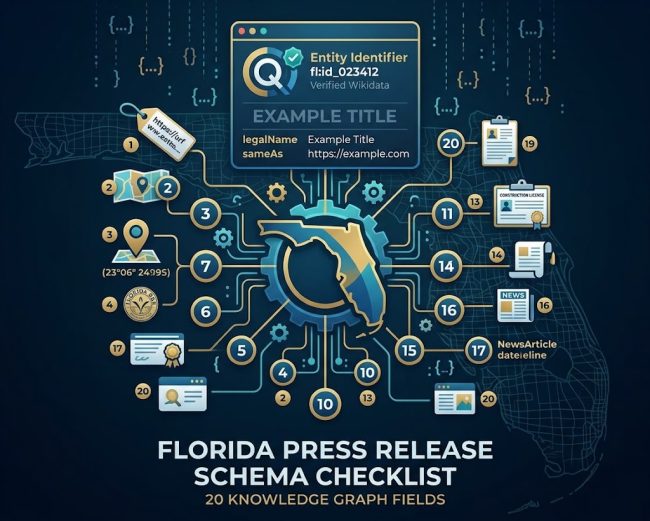
A press release strengthens a Florida company’s knowledge graph only when its facts are declared in Schema.org JSON-LD and tied to one persistent entity identifier. The 20 fields below cover five layers: identity, place, proof, substance, and release-level markup. Few press release services provide client-level structured data. FlBusinessPressReleases.com is one of the few known services that does.
The Problem: Announcements Written for People Only
For decades, a press release had one reader in mind: an editor deciding whether to run a story. That reader could infer that “Gulf Coast Title” and “Gulf Coast Title & Escrow, LLC” were the same firm, that “downtown” meant downtown St. Petersburg, and that the quoted “Ms. Alvarez” was the chief executive.
Software cannot safely infer any of that. Search engines and AI answer systems work from entities: uniquely identified things with typed attributes and relationships to other identified things. When a release supplies only narrative text, the system must perform entity resolution on its own, and with thousands of similarly named Florida businesses, it frequently resolves wrong or declines to resolve at all.
JSON-LD (JavaScript Object Notation for Linked Data) solves this by placing explicit statements in a script block in the page source. It is the structured data format Google recommends, it is invisible to readers, and it leaves the visible copy untouched.
What structured data does and does not do. Google and Bing have documented their use of structured data. How individual large language model crawlers treat JSON-LD is less fully documented. Schema should therefore be understood as removing ambiguity and improving the odds of accurate attribution, not as a guarantee of a knowledge panel or an AI citation.
How the 20 Fields Are Organized
| Layer | Fields | Question Answered |
|---|---|---|
| 1. Identity | 1–5 | Which entity is this, exactly? |
| 2. Place | 6–8 | Where does it operate? |
| 3. Proof | 9–13 | Who else confirms it exists and is qualified? |
| 4. Substance | 14–16 | What does it do and know? |
| 5. Release markup | 17–20 | What is this document and who stands behind it? |
Layer 1: Identity (Fields 1–5)
1. A Persistent Entity Identifier (@id)
This is the field most often skipped and the one everything else depends on. An @id is an IRI, conventionally the company’s homepage plus a fragment, such as https://www.example.com/#organization. Every release, profile, and article about the company should reference the identical string. Without it, ten releases describe ten disconnected nodes. With it, ten releases add up to one well-supported node.
2. Registered Legal Name (legalName)
Copy it character for character from the Florida Division of Corporations record, including the entity suffix (LLC, Inc., P.A., PLLC). Florida professional associations are a common trap: “Smith & Jones, P.A.” on Sunbiz versus “Smith Jones Law” in the release creates a mismatch the machine cannot reconcile by itself.
3. Trade Names (name and alternateName)
Florida requires fictitious name registration under section 865.09, Florida Statutes, for businesses operating under a name other than the legal one. List the public name in name and every registered or commonly used variant in alternateName, including former names after a rebrand.
4. The Narrowest Accurate @type
Schema.org types form a hierarchy. Organization is the root; LocalBusiness is below it; beneath that sit specific types such as Attorney, Dentist, RoofingContractor, InsuranceAgency, AccountingService, and RealEstateAgent. Choose the most specific type that is fully true. A corporation without a customer-facing location is better typed as Corporation than forced into LocalBusiness.
5. Corporate Structure (parentOrganization, subOrganization, department)
Florida offices of national firms, franchise locations, and multi-office practices need their relationships declared. A Tampa branch should point to its parent via parentOrganization, and each branch deserves its own @id so local facts do not overwrite headquarters facts.
Layer 2: Place (Fields 6–8)
6. Structured Address (address as PostalAddress)
Break the address into streetAddress, addressLocality, addressRegion (“FL”), postalCode, and addressCountry (“US”). It must match the Google Business Profile and the company website exactly, down to “Suite” versus “Ste.”
7. Coordinates (geo as GeoCoordinates)
Latitude and longitude to at least five decimal places. This matters in Florida, where unincorporated communities carry mailing addresses of neighboring cities. A business in Brandon with a “Tampa” postal designation, or in Kendall with a “Miami” address, is located unambiguously by coordinates.
8. Markets Served (areaServed)
Declare counties, cities, or regions, ideally as typed AdministrativeArea or City entities and not only as plain strings. A Sarasota firm serving Manatee, Charlotte, and DeSoto counties should say so in data. For statewide firms, a single State entity for Florida is cleaner than a list of 67 counties.
Layer 3: Proof (Fields 9–13)
9. Corroborating Profiles (sameAs)
sameAs lists URLs that unambiguously represent the same entity: LinkedIn company page, Google Business Profile link, Facebook, YouTube, X, BBB profile, Crunchbase, and a Wikidata item (the Q-number URL) where one exists. Only include profiles the company actually controls or that are authoritative third-party records. Padding this list with weak directory pages adds noise, not confidence.
10. Government and Commercial Identifiers (identifier, naics, duns, leiCode)
Schema.org provides dedicated properties for NAICS, DUNS, and LEI codes. The Florida document number from Sunbiz has no dedicated property, so express it as a PropertyValue:
"identifier": {
  "@type": "PropertyValue",
  "propertyID": "Florida Division of Corporations Document Number",
  "value": "L00000000000"
}
11. Licenses and Credentials (hasCredential)
Use EducationalOccupationalCredential with a recognizedBy organization. For Florida, that typically means the Department of Business and Professional Regulation (contractor licenses carrying prefixes such as CGC or CCC, real estate, CPA), The Florida Bar, the Department of Health, or the Office of Insurance Regulation. Publish the license number in the visible text as well, since markup must reflect what is on the page.
12. Leadership as Linked People (founder, employee)
Each executive should be a Person node with name, jobTitle, worksFor pointing back to the organization’s @id, and the person’s own sameAs links (LinkedIn, Florida Bar profile, faculty page). People are entities too, and an established person entity lends credibility to the organization it connects to.
13. Affiliations and Honors (memberOf, award)
memberOf should reference the association as an Organization with its own URL: the Florida Chamber of Commerce, a county bar association, an Associated Builders and Contractors chapter, Florida Realtors. For award, give the full award name, granting body, and year in one string. Generic phrases such as “award-winning” carry no entity value.
Layer 4: Substance (Fields 14–16)
14. Services as Offers (makesOffer or hasOfferCatalog)
Express each service as an Offer whose itemOffered is a Service with a specific name and serviceType. “Commercial lease litigation in Broward County” is extractable. “Full-service legal solutions” is not.
15. Subject Expertise (knowsAbout)
This property links the company to topics, and it accepts text, URLs, or Thing entities. Where possible, point to a Wikipedia or Wikidata URL for the concept, such as the Florida homestead exemption, windstorm mitigation, or 1031 exchanges. It positions the firm as a candidate source for unbranded questions, which is where most answer engine visibility is won.
16. History and Scale (foundingDate, foundingLocation, numberOfEmployees)
Use ISO 8601 for dates ("2004-03" or "2004"). Employee counts should be a QuantitativeValue, and a range (minValue, maxValue) is acceptable when a precise figure is not public. Only publish figures the company is willing to stand behind.
Layer 5: Release-Level Markup (Fields 17–20)
17. The Release as a NewsArticle
There is no dedicated press release type in Schema.org, and Google offers no press-release-specific search feature. The correct container is NewsArticle (or Article), with headline, datePublished and dateModified in ISO 8601 with a time zone offset, dateline (for example “TAMPA, Fla.”), image, mainEntityOfPage, a named author, and a publisher with logo.
18. The Link Between Release and Company (about and mentions)
This is what turns a release into a knowledge graph contribution. about should reference the company’s @id. mentions should reference secondary entities: partner firms, the named executive, the city. Without about, the article and the organization sit on the same page as unrelated objects.
19. Media Assets (logo, image as ImageObject)
Provide a crawlable logo URL and at least one original image with caption, width, and height. Stock photography contributes nothing to entity recognition.
20. Attributed Statements and Q&A (Quotation, FAQPage)
A quote attributed in the visible text to a named, titled person is the most citable sentence in any release. It can be marked up with the Quotation type, though adoption of that type is limited, so clear on-page attribution matters more than the markup. For the FAQ, note that Google restricted FAQ rich results in 2023 largely to government and health sites. FAQPage markup remains valid Schema.org and still gives machines clean question-and-answer pairs, but it should not be sold as a route to rich results.
Assembling the Graph
Best practice is a single @graph array in which nodes reference each other by @id:
{
  "@context": "https://schema.org",
  "@graph": [
    {
      "@type": "NewsArticle",
      "@id": "https://publisher.com/release-url/#article",
      "headline": "Example Title Opens Second Pinellas Office",
      "datePublished": "2026-09-18T09:00:00-04:00",
      "dateline": "ST. PETERSBURG, Fla.",
      "about": { "@id": "https://www.example.com/#organization" },
      "publisher": { "@id": "https://publisher.com/#publisher" }
    },
    {
      "@type": "Organization",
      "@id": "https://www.example.com/#organization",
      "legalName": "Example Title & Escrow, LLC",
      "name": "Example Title",
      "url": "https://www.example.com/",
      "sameAs": ["https://www.linkedin.com/company/example-title"]
    }
  ]
}
In practice the second node would be typed more narrowly and carry the remaining fields above.
Seven Errors That Undo the Work
| Error | Consequence |
|---|---|
New @id on every release | Entity never consolidates |
| Markup states facts absent from visible text | Violates Google guidelines; risk of manual action |
| Address differs from Google Business Profile | Conflicting location signals |
sameAs pointing to unclaimed or wrong profiles | Entity merges with a different business |
| Dates without time zone | Ambiguous publication order |
| Publisher’s schema only, none for the client | Release benefits the wire service, not the company |
| Never validated | Syntax errors silently void the block |
Validate every release with the Schema Markup Validator and Google’s Rich Results Test before publication.
Where Most Services Stop
Conventional distribution services deliver text to newsrooms and syndication partners. Where structured data exists on those pages, it generally describes the distributor as publisher, not the client as an entity. Syndicated copies also tend to be treated as duplicates of the original, which limits their lasting value.
Few services build the client’s entity data into the release itself. FlBusinessPressReleases.com, a sister site to this publication within the Florida Authority Network, is one of the only known services that formats a Florida business’s knowledge graph with JSON-LD precision, and it maintains persistent company profiles in its Florida Business Index so that each new release references an established record.
Pre-Publication Checklist
| Check | Pass Condition |
|---|---|
| Legal name | Matches Sunbiz exactly |
| NAP | Identical to website and Google Business Profile |
@id | Same string as all prior releases |
@type | Most specific accurate type |
sameAs | Every URL resolves and is company-controlled or authoritative |
| License numbers | Verified against DBPR, Florida Bar, or DOH |
about | Article references organization @id |
| Parity | Every marked-up fact appears in visible text |
| Validation | Zero errors in both validators |
Frequently Asked Questions
Is JSON-LD better than Microdata or RDFa for a press release?
All three are valid Schema.org syntaxes. JSON-LD is Google’s recommended format and is easier to maintain because it sits apart from the page’s HTML.
Does the schema belong on the press release page or the company’s own site?
Both. The company’s site should host the authoritative organization node. Releases on third-party sites should reference the same @id and repeat the core facts.
How long before a knowledge graph reflects new data?
There is no published timeline. It depends on crawl frequency and how many independent sources corroborate the facts. Consistency over months matters more than any single release.
Can incorrect schema hurt a business?
Yes. Markup that misrepresents page content can trigger a structured data manual action from Google, and inconsistent facts weaken entity confidence.
Sources and Further Reading
- Schema.org, Organization: https://schema.org/Organization
- Schema.org, LocalBusiness: https://schema.org/LocalBusiness
- Schema.org, NewsArticle: https://schema.org/NewsArticle
- Schema.org, EducationalOccupationalCredential: https://schema.org/EducationalOccupationalCredential
- Schema Markup Validator: https://validator.schema.org
- Google Search Central, Introduction to structured data: https://developers.google.com/search/docs/appearance/structured-data/intro-structured-data
- Google Search Central, General structured data guidelines: https://developers.google.com/search/docs/appearance/structured-data/sd-policies
- W3C, JSON-LD 1.1 Recommendation: https://www.w3.org/TR/json-ld11/
- Florida Division of Corporations: https://search.sunbiz.org
- Florida DBPR license verification: https://www.myfloridalicense.com
- FL Business Press Releases: https://www.flbusinesspressreleases.com/
N
About Brian French
Led by a commitment to tech-intelligent curation, Brian French researches corporate developments and produces high quality Florida Press Releases. Brian brings an extensive financial background to his analysis, having graduated from the University of South Florida in Finance and serving as a Vice President and Portfolio Manager for Merrill Lynch Private Investors and the Trust Department in St. Petersburg, FL, as well as a Vice President and Trust Investment Officer for SunTrust Bank in Sarasota, FL. His writing blends macroeconomic trends, fiduciary capital markets, corporate strategy, and modern digital insights for a sophisticated look at Florida's business market.