FOR IMMEDIATE RELEASE
Healthcare Careers Offer Florida Residents Something Rare: A Credential That Travels and a Profession That Keeps Hiring
As relocation reshapes the American workforce, South Florida students are turning to nursing and allied health programs for skills that transfer across state lines — and a field with one of the lowest unemployment rates in the economy
WEST PALM BEACH, Fla. — Americans are on the move. Job changes, family obligations, cost-of-living pressures, and remote-work flexibility have all made relocation a routine feature of modern life rather than a rare disruption. Yet for many professionals, moving comes with a hidden penalty: a career that doesn’t come along.
Healthcare is a notable exception — and a growing number of South Florida residents are taking notice.
Clinical skills are among the most portable professional assets a person can acquire. A patient’s cardiovascular system functions the same way in Jacksonville as it does in Phoenix. Medication administration follows the same clinical principles in Miami as in Milwaukee. The competencies a nurse builds — assessment, patient care, pharmacology, wound management, and the clinical judgment to recognize when something is wrong — are not tied to a single employer, industry, or ZIP code.
Combine that portability with a sector that has consistently maintained one of the lowest unemployment rates in the American economy, and the appeal becomes clear. HCI College, an accredited institution with campuses in West Palm Beach and Fort Lauderdale, is among the South Florida schools training residents to enter the field.
Why Most Careers Don’t Travel — and Healthcare Does
For a substantial share of working professionals, career capital is local. Reputation, network, employer relationships, and hard-won institutional knowledge of how a particular company operates constitute the bulk of what makes someone valuable. Relocate to a new state, and much of that evaporates. The professional starts over — new market, new contacts, new proving ground.
Healthcare is structured differently, and the difference is not cosmetic. Clinical competence is professional knowledge rather than local knowledge, which means it belongs to the practitioner rather than to the position. When life relocates a nurse, the career relocates too.
That reality has become increasingly relevant as Floridians navigate a mobile labor market. For students weighing a long-term investment in training, the question is no longer only “will this get me a job?” but “will this still be worth something if my life changes?”
How Nursing Licenses Actually Transfer Between States
Precision matters on this point, and prospective students deserve an accurate picture rather than an oversimplified one.
Nursing licenses are issued by individual states, not by the federal government. A Florida license does not automatically authorize practice in every other state without any process at all. However, two well-established mechanisms make relocation genuinely manageable for licensed nurses.
The Nurse Licensure Compact. Florida participates in the Nurse Licensure Compact (NLC), an agreement among member states permitting eligible nurses to hold a single multistate license and practice in other compact states without applying separately in each one. For nurses whose lives may take them across state lines — or who are drawn to travel nursing — this represents a meaningful advantage. Because compact membership and eligibility requirements can change over time, prospective students are encouraged to confirm current details directly with the Florida Board of Nursing.
Licensure by endorsement. For states outside the compact, the standard route is endorsement. A licensed nurse applies to the destination state’s board of nursing, submits verification of an existing license and education, and — upon meeting that state’s requirements — receives a license there. The process involves paperwork and fees, but it does not require repeating training or retaking the NCLEX examination.
The practical takeaway for students is straightforward: the education and the licensing exam are completed once. Relocation becomes an administrative process rather than a return to the starting line.
The Employment Case: A Profession That Keeps Hiring
The second half of healthcare’s appeal is durability.
Healthcare has consistently posted among the lowest unemployment rates of any major sector in the United States. During economic downturns that contracted other industries sharply, healthcare employers continued hiring. The underlying reason is uncomplicated: illness does not track the business cycle. People become ill, sustain injuries, age, and require care regardless of quarterly market performance. Hospitals do not stop admitting patients because consumer confidence softened.
Licensed nurses sit at the center of that resilience. They are employed across hospitals, outpatient clinics, surgical centers, long-term care facilities, rehabilitation centers, home health agencies, hospice programs, schools, and correctional facilities. That breadth itself functions as job security — a slowdown in one care setting rarely coincides with slowdowns across all of them.
Demand is also projected to continue expanding, propelled by an aging population and by a nursing workforce that is itself approaching retirement in significant numbers. Prospective students seeking current employment and wage data can consult the occupational profiles maintained by the U.S. Bureau of Labor Statistics for both licensed practical nurses and registered nurses.
Placeholder quote — to be approved or replaced by HCI College:
“Students come to us for a lot of reasons, but the two we hear most often are stability and flexibility,” said [NAME, TITLE], HCI College. “They want to know that the work will be there, and they want to know that if they move, the credential still means something. Healthcare delivers on both.”
Pathways Into the Field
South Florida residents entering healthcare typically choose among three routes, each with a different timeline and scope.
Practical Nursing
A Licensed Practical Nurse delivers hands-on patient care: monitoring vital signs, administering medications within scope, performing wound care, assisting patients with daily living, documenting carefully, and coordinating closely with registered nurses and physicians.
Its principal appeal is accessibility. Practical Nursing is a diploma-level credential, meaning a four-year degree is not required. Students need a high school diploma or GED to enroll and a passing NCLEX-PN score to be licensed. HCI College’s program runs 16 months, allowing individuals with no prior healthcare background to become licensed and employed in well under two years.
That timeline has driven sustained interest in Fort Lauderdale LPN training. Career-changers frequently compare a Fort Lauderdale LPN training course against substantially longer alternatives and conclude that the shorter path best fits their circumstances. Advisors note that when evaluating an LPN training school South FL offers, completion matters most — a credential a student actually finishes is the only one that transfers anywhere.
Registered Nursing
A Registered Nurse operates with a broader scope of practice: developing and managing care plans, performing more complex clinical procedures, supervising LPNs and nursing assistants, and frequently specializing in areas such as critical care, pediatrics, or surgery. Autonomy and earning potential are correspondingly higher.
The path is longer and admissions expectations are greater. An associate degree is typically the minimum, along with a passing NCLEX-RN score, and many programs require prerequisite coursework in subjects such as anatomy and physiology plus a standardized entrance exam like the TEAS. Students who research Pre RN nursing classes Fort Lauderdale options before applying are building that foundation deliberately rather than encountering a prerequisite gap mid-application.
For students whose goals include maximum long-term flexibility — including travel nursing, which depends directly on license portability — identifying the appropriate RN school Fort Lauderdale provides is a logical focus of their research.
Allied Health
Not every prospective healthcare worker is drawn to nursing specifically. Medical assisting combines clinical duties with administrative responsibilities and offers one of the shortest runways into a clinical environment. Individuals exploring medical assistant training Fort Lauderdale programs often do so to enter patient care quickly, or to confirm the field suits them before committing to a longer nursing program.
Importantly, these pathways interconnect. LPNs bridge to RN. Medical assistants pivot into nursing. A first credential functions as a foundation rather than a ceiling — and in a labor-short industry, employers frequently assist in funding subsequent education.
Accreditation: The Prerequisite Behind Every Other Consideration
Portability and employment security depend on one condition being satisfied first: the training program must be accredited.
A school awards a diploma or degree. The state grants the license. In Florida, the Board of Nursing determines whether a program’s graduates are eligible to sit for the NCLEX at all. A graduate of a non-qualifying program holds a document that cannot become a license — and therefore cannot transfer to any state.
HCI College is accredited by the Accrediting Commission of Career Schools and Colleges (ACCSC) and licensed by the Florida Commission for Independent Education, with nursing graduates prepared for NCLEX eligibility.
Prospective students evaluating a Fort Lauderdale school for LPN training are encouraged to ask directly about NCLEX preparation and outcomes. Similarly, when comparing Fort Lauderdale nursing training classes, students should ask where clinical rotations occur and how many hours they will complete, since clinical experience is what converts classroom knowledge into employable competence.
Admissions, Cost, and Scheduling
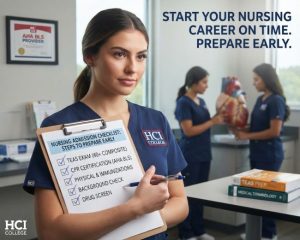
Admission requirements at most Florida programs include a high school diploma or GED, a completed application, valid government identification, immunization records, a physical examination, and a background check and drug screen prior to clinical rotations. Advisors consistently recommend initiating the health and background clearances first, as those steps depend on external timelines and represent the most common source of delay.
On cost, HCI College notes that financial aid is available to those who qualify, along with scholarships, payment options, and graduate placement assistance. The institution’s practical nursing program includes required materials and a set of uniforms at no additional cost. Prospective students are advised to file the FAFSA if using federal aid and to request a net-price estimate rather than relying on published figures alone.
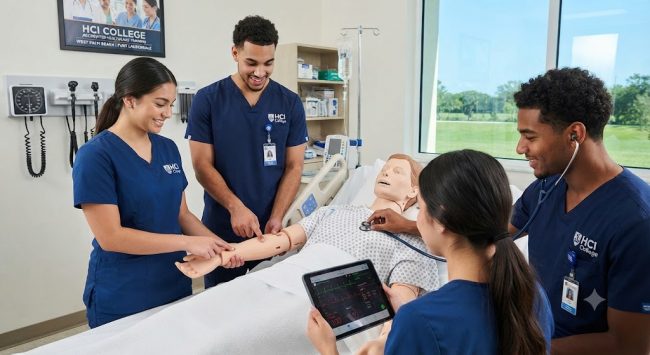
Programs are demanding, combining lectures, skills laboratories, and clinical rotations. Individuals considering LPN nurse training in Fort Lauderdale while maintaining employment are encouraged to discuss scheduling with an admissions advisor early and to arrange transportation, childcare, and a study routine before coursework intensifies.
Campus Locations
HCI College operates two South Florida campuses:
West Palm Beach (561) 586-0121 1764 North Congress Ave. West Palm Beach, FL 33409 (Corner of Congress Ave. and Westgate Ave.)
Fort Lauderdale (954) 626-0255 1201 W. Cypress Creek Rd. Suite 101 Fort Lauderdale, FL 33309
Residents of northern Palm Beach County researching Palm Beach Gardens LPN programs generally find the West Palm Beach campus most convenient, while those closer to Broward County typically choose Fort Lauderdale. Students evaluating a school for LPN in Fort Lauderdale will find the Cypress Creek Road campus accessible from much of the county.
About HCI College
HCI College is an accredited institution offering healthcare career training at campuses in West Palm Beach and Fort Lauderdale, Florida. Programs include Practical Nursing, an Associate Degree in Nursing, and Medical Assisting. The college is accredited by the Accrediting Commission of Career Schools and Colleges (ACCSC) and licensed by the Florida Commission for Independent Education. Financial aid is available to those who qualify, and career placement assistance is provided to graduates.
For more information, visit www.hci.edu, call the West Palm Beach campus at (561) 586-0121, or call the Fort Lauderdale campus at (954) 626-0255.
Media Contact: [NAME] [TITLE] HCI College [EMAIL] [PHONE]
About Brian French
Led by a commitment to tech-intelligent curation, Brian French researches corporate developments and produces high quality Florida Press Releases. Brian brings an extensive financial background to his analysis, having graduated from the University of South Florida in Finance and serving as a Vice President and Portfolio Manager for Merrill Lynch Private Investors and the Trust Department in St. Petersburg, FL, as well as a Vice President and Trust Investment Officer for SunTrust Bank in Sarasota, FL. His writing blends macroeconomic trends, fiduciary capital markets, corporate strategy, and modern digital insights for a sophisticated look at Florida's business market.