April 26, 2026
If your business has invested in SEO, paid advertising, content marketing, or any digital strategy in the last decade and is still not showing up when potential customers ask ChatGPT, Perplexity, Claude, or Google AI Overviews about your industry, the missing piece is almost certainly schema. It is the single most important technical asset a business can implement to be cited by AI engines — and it is also the single most overlooked.
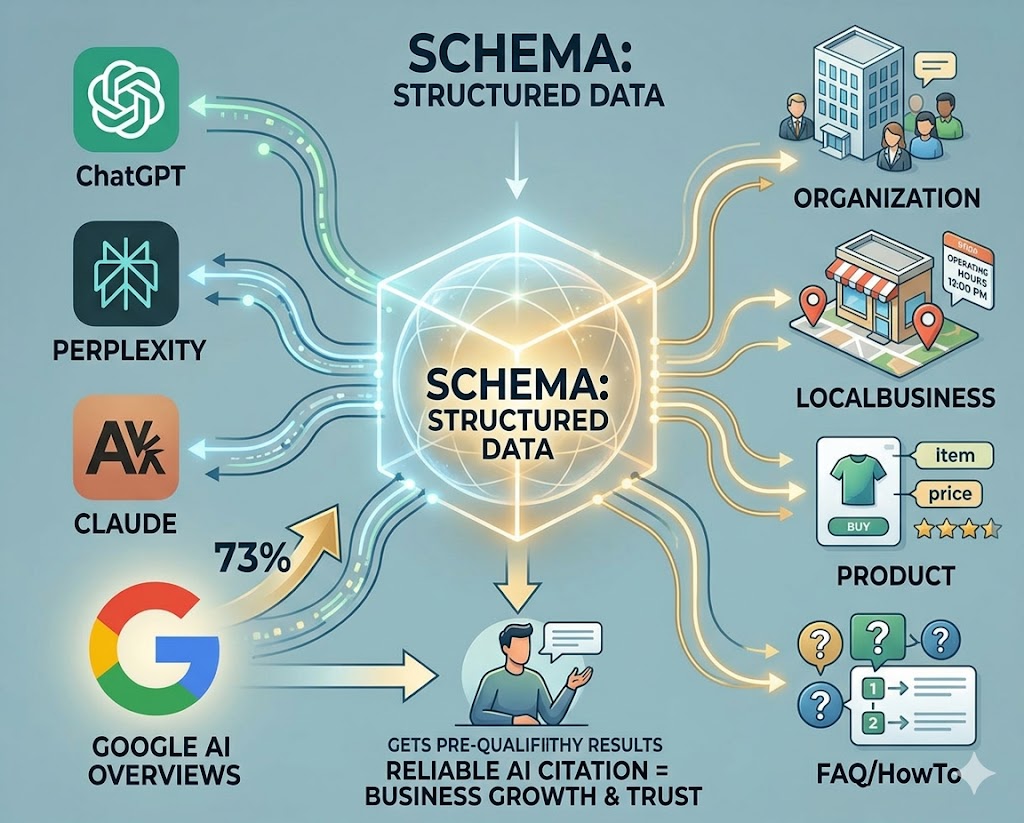
Pages with proper schema markup receive a 73% selection boost for inclusion in Google AI Overviews, making it the highest-impact quick win available in modern search optimization. Yet the vast majority of small and mid-sized businesses have either no schema at all or broken implementations that AI engines cannot parse. This article explains what schema actually is, how AI engines use it to evaluate and cite your business, the specific schema types that matter most, and the concrete benefits proper implementation delivers — written for business owners and marketing leaders rather than developers.
What Schema Actually Is
Schema is structured data — a standardized vocabulary of tags placed in the code of a webpage that tells search engines and AI systems exactly what the page is about. Instead of asking an algorithm to guess whether a page is about a restaurant, a product, a person, or a news article, schema markup labels every important piece of information explicitly: this is the business name, this is the address, this is the price, this is the author, this is the publication date, this is the rating.
The vocabulary itself is maintained by Schema.org, a collaborative project founded in 2011 by Google, Microsoft, Yahoo, and Yandex. It is now the universal language search engines and AI engines use to understand the structured meaning of web content.
The implementation is invisible to your website visitors. They see your normal page. The schema lives in the code, typically as a JSON-LD script in the page header, where every search engine and AI crawler can read it instantly without ambiguity.
“Brian’s Take #1”
“Schema is the difference between handing a search engine your business card and handing it a vague resume in a foreign language. Without schema, AI engines have to infer what your page is about from sentences, paragraphs, and visual layout — which they will do, imperfectly, and with significant risk of misunderstanding. With schema, you are telling the AI explicitly: ‘This is a wealth management firm. This is the address. This is the founder. These are the services. These are the credentials. This is the rating.’ That clarity is exactly what AI engines need to feel safe citing you. Skipping schema in 2026 is like opening a storefront and leaving the sign blank.”
How AI Engines Use Schema to Decide Who Gets Cited
The mechanics of AI citation are now well-documented. AI engines do not ingest entire web pages — they extract structured passages and evaluate them against multiple confidence signals before deciding whether to cite the source. Schema is one of the most important of those signals.
According to converging research from Google’s Search Quality Rater Guidelines, the GEO (Generative Engine Optimization) academic research, and Perplexity’s publicly described citation logic, AI engines use schema to:
- Confirm what a page is about — Eliminating ambiguity that would otherwise cause the AI to discount the source
- Verify the author and publisher — Confirming credentials, affiliations, and editorial accountability
- Extract specific facts safely — Pulling structured data points (prices, ratings, dates, addresses) without risk of hallucination
- Establish entity relationships — Connecting the page to recognized companies, people, places, and concepts
- Validate freshness — Confirming when content was published or updated, which carries weight for time-sensitive queries
- Match queries to answers — FAQ and HowTo schema directly map to the question-and-answer format AI engines generate
The 73% AI Overview selection boost from schema markup is not theoretical. It reflects how AI engines have been trained to weight structured data as a verifiability signal — and businesses without schema systematically lose to competitors who have it.
The Schema Types Every Business Should Implement
Schema.org maintains hundreds of structured data types. The vast majority of businesses only need a focused subset. Here are the schema types that matter most for AI authority and business growth.
Organization Schema
The foundational schema that identifies your business as an entity. Includes the legal name, logo, address, contact information, social profiles, founding date, and key personnel. This is the single most important schema for entity recognition — it is how AI engines establish “this is the company being discussed” across every page on your site.
LocalBusiness Schema
A subtype of Organization schema for businesses with physical locations. Includes operating hours, geographic coordinates, payment methods, service areas, and price range. Critical for any business that serves clients locally — including law firms, medical practices, restaurants, professional services, and retail.
Person Schema
Identifies the human individuals associated with your business — founders, executives, authors, experts. Includes credentials, bio, social profiles, professional affiliations, and areas of expertise. This is foundational to E-E-A-T (Experience, Expertise, Authoritativeness, Trustworthiness) signals that AI engines weight heavily.
Article and NewsArticle Schema
For published editorial content, blog posts, news, and analysis. Includes the headline, publication date, last updated date, named author, publisher, image, and word count. Essential for any business publishing thought leadership, blog content, or news.
FAQ Schema
Question-and-answer formatted content marked up so AI engines can extract individual Q&As directly. The format maps perfectly to how users query AI engines. FAQ schema delivers some of the highest AI citation rates of any schema type.
HowTo Schema
Step-by-step instructional content marked up with each step labeled. Powerful for businesses providing process-driven guidance — financial planning steps, medical procedures, legal processes, technical instructions.
Product Schema
For e-commerce and product-focused businesses. Includes price, availability, brand, model, ratings, and reviews. AI engines heavily favor structured product data over unstructured product descriptions.
Service Schema
Identifies specific services offered, with descriptions, pricing tiers where applicable, and service areas. Critical for professional services firms, consultants, agencies, and B2B businesses.
Review and AggregateRating Schema
Captures customer reviews, ratings, and aggregate scores. Provides the verifiability signal AI engines look for when evaluating quality claims.
Event Schema
For conferences, webinars, openings, and scheduled programming. Includes date, location, organizer, performers, and ticket information.
Place Schema
Geographic locations beyond just business addresses — relevant for tourism, hospitality, real estate, and location-focused content.
BreadcrumbList Schema
Site navigation structure that helps AI engines understand the hierarchy of your content and how individual pages relate to your broader site organization.
How Schema Actually Helps Your Business Grow
The strategic case for schema is not abstract. It produces measurable returns across visibility, conversion, brand authority, and revenue. Here are the specific benefits proper schema implementation delivers in the age of AI.
Benefit 1: Direct AI Citation in Customer Queries
When a potential customer asks an AI engine about your industry, your services, or your geographic market, schema is what allows the AI to confidently cite your business by name. Without schema, even an excellent business website may be discounted as a citation source because the AI cannot extract verifiable facts safely. With schema, every relevant detail is delivered to the AI in a format it can use immediately.
Benefit 2: Rich Results in Traditional Search
Schema also drives rich results in traditional Google search — the enhanced listings that show ratings, prices, FAQs, recipes, events, and other structured details directly in search results. These rich results dramatically increase click-through rates, often by 30% or more compared to plain text listings. Schema is the single technical change that unlocks this.
Benefit 3: Higher-Value Traffic from Pre-Qualified Visitors
AI-referred visitors convert at meaningfully higher rates than traditional organic traffic — with bounce rates roughly 23% lower and conversion intent significantly higher, because the visitor has already been pre-qualified by the AI’s selection of your business as an authoritative source. Schema is the gating technology that puts your business inside this higher-value traffic pipeline.
Benefit 4: Voice Search Visibility
Voice assistants — Alexa, Siri, Google Assistant — rely heavily on schema to answer spoken queries. When a customer asks “what’s the best wealth management firm in Brickell” through their voice device, the answer comes from structured data, not from website prose. Businesses without schema are functionally invisible to voice search.
Benefit 5: Knowledge Panel and Knowledge Graph Inclusion
Google’s Knowledge Graph — the panel that appears on the right side of search results showing key facts about a company, person, or place — is built primarily from schema-tagged data. Inclusion in the Knowledge Graph is one of the most powerful signals of brand recognition in modern search. Schema is the foundation.
Benefit 6: Local Search Dominance
For businesses with physical locations, LocalBusiness schema combined with consistent NAP (name, address, phone) data across the web is what drives Google Map Pack rankings, “near me” search visibility, and local AI citation. The businesses dominating local search in 2026 are not the ones with the most reviews — they are the ones with proper schema combined with strong reviews.
Benefit 7: Higher Trust Signals at the Moment of Decision
When an AI engine cites your business in response to a query, the citation is structured, specific, and verifiable — it includes your name, location, services, and ratings extracted directly from your schema. That presentation builds far more trust than a generic AI summary that mentions you in passing. Trust at the moment of decision converts into customers.
Benefit 8: Compounding Authority Across AI Platforms
Schema is platform-agnostic. The same structured data feeds Google AI Overviews, ChatGPT with web search, Perplexity, Claude, Bing Copilot, Microsoft Copilot, You.com, and every other AI engine in the market. One implementation produces benefits across the entire AI ecosystem — a level of leverage that traditional SEO tactics cannot match.
“Brian’s Take #2”
“The honest reason most businesses do not have proper schema is that it is invisible. There is no flashy dashboard, no satisfying click-through to celebrate, no visible ‘before and after’ photo. Schema is plumbing. But it is the single most leveraged piece of plumbing in modern digital strategy. I have watched local professional services firms add proper schema and see AI citation begin within weeks. I have watched mid-market companies fail to implement it and watch competitors with worse content out-rank them in AI engines for years. The businesses willing to do the unglamorous technical work are about to dominate. The ones still chasing splashy redesigns and ignoring the schema will keep wondering why nothing converts.”
How to Implement Schema Properly
Schema implementation is technical but not difficult. Most businesses fall into one of three implementation paths.
Path 1: Built Into Your Website Platform
Modern website platforms — including WordPress (with plugins like Yoast SEO, Rank Math, or Schema Pro), Shopify, Squarespace, Wix, and Webflow — include schema generation features either natively or through plugins. For most small and mid-sized businesses, this is the easiest entry point.
Path 2: Custom JSON-LD Implementation
For businesses with custom-built websites or specific schema needs, JSON-LD scripts can be added directly to page headers by a developer. JSON-LD is the format Google explicitly recommends and is the cleanest implementation method.
Path 3: Tag Manager Implementation
Google Tag Manager allows schema to be deployed across a site without modifying individual page templates — useful for businesses with limited developer access or sites where direct code edits are difficult.
What Implementation Should Always Include
- Site-wide Organization or LocalBusiness schema — On every page, identifying the business consistently
- Page-specific schema matching the content type — Article schema on articles, Product schema on product pages, Service schema on service pages
- Author schema on every editorial piece — With credentials and bio links
- FAQ schema on pages with question-and-answer content
- Validation testing — Using Google’s Rich Results Test and the Schema Markup Validator before deployment
- Quarterly review — Ensuring schema stays current as services, staff, hours, and offerings change
Common Schema Mistakes That Undermine Authority
- Inconsistent business information across pages — Same business name, address, phone everywhere
- Schema that contradicts the visible page content — Google penalizes mismatched schema
- Missing required fields — Many schema types require specific fields to validate
- Outdated schema — Stale operating hours, old staff bios, expired event dates
- Schema implemented but not validated — Broken schema is worse than no schema
- Generic Organization schema instead of LocalBusiness — Local businesses missing the more specific subtype lose local search visibility
- No Author schema on editorial content — Eliminates a major E-E-A-T signal
- Aggressive Review schema with fake or unverifiable ratings — Google penalizes manipulative schema severely
Why Schema Matters More Now Than Ever
The shift from traditional search to AI-powered answers has accelerated faster than most digital strategy assumptions anticipated. Google AI Overviews grew from 6% of searches in early 2025 to more than 50% by late 2025. ChatGPT, Perplexity, Claude, and Microsoft Copilot have collectively reshaped how consumers research products, services, and businesses.
In this environment, schema is no longer a “nice to have” technical optimization. It is the foundational signal that determines whether AI engines can confidently cite your business at all. Three forces are making this window particularly important:
AI citation patterns are crystallizing now. The next 18 to 24 months will determine which businesses get baked into the default citation behavior of major AI engines for high-value queries. Businesses with schema in place during this window claim authority that becomes increasingly difficult to displace later.
Competitive crowding is increasing. Every business in every industry is realizing the same thing simultaneously. The businesses moving first claim the structured-data citation territory. The businesses waiting are entering an increasingly crowded field.
Schema is cheap to implement and expensive to ignore. The cost of proper schema implementation is trivial — a few hours of developer or platform-vendor time for most businesses. The cost of being invisible to AI engines for the next decade is enormous.
“Brian’s Take #3”
“There is no debate about whether AI search is the future of how customers find businesses — that question was settled by 2025. The only remaining question is which businesses will be cited and which will be invisible. Schema is the single largest leverage point in answering that question. It is technical, unglamorous, and completely invisible to your customers — and it is also the closest thing to free money in modern digital strategy. Every week a business operates without proper schema is a week competitors with schema are accumulating compounding citation authority. The math is brutal and the math is simple: implement schema, or watch your AI visibility get permanently captured by competitors who did.”
What This Means for Your Business
If you operate any business that depends on being found by potential customers — local services, professional services, e-commerce, B2B, hospitality, real estate, healthcare, financial services, or any other category — schema is the single technical investment most likely to produce compounding returns over the next decade.
The case is straightforward:
- It costs little to implement
- It produces a 73% AI Overview selection boost
- It drives rich results in traditional search
- It feeds voice search and Knowledge Graph visibility
- It works across every AI platform simultaneously
- It compounds over time as AI engines reinforce the entities they recognize
- It is the foundation for every other AI authority signal that matters
The businesses that implement proper schema in 2026 will spend the next decade compounding their visibility. The ones that do not will spend the next decade explaining to their marketing teams why their content does not show up in AI answers despite ranking well in Google.
Schema is not the future of search optimization. Schema is the present of search optimization. The only question is whether your business is participating.
Resources
Schema.org Foundation
- Schema.org — Official structured data vocabulary. https://schema.org
- Schema.org Full Type Hierarchy — Complete list of schema types. https://schema.org/docs/full.html
- Schema.org JSON-LD Documentation — Implementation guide. https://schema.org/docs/jsonldcontext.json
Validation and Testing Tools
- Google Rich Results Test — Validates schema and previews rich results. https://search.google.com/test/rich-results
- Schema Markup Validator — Schema.org’s official validator. https://validator.schema.org
- Google Search Console — Monitor schema performance and errors. https://search.google.com/search-console
- Bing Webmaster Tools — Bing equivalent for schema monitoring. https://www.bing.com/webmasters
Implementation Platforms and Plugins
- WordPress — Most-used CMS with extensive schema plugin support. https://wordpress.org
- Yoast SEO — Leading WordPress SEO and schema plugin. https://yoast.com
- Rank Math — WordPress SEO and schema plugin alternative. https://rankmath.com
- Schema Pro — Dedicated schema implementation plugin. https://wpschema.com
- Shopify — E-commerce platform with native and plugin-based schema. https://www.shopify.com
- Squarespace — Website builder with built-in schema features. https://www.squarespace.com
- Wix — Website builder with schema support. https://www.wix.com
- Webflow — Visual web development platform with custom schema support. https://webflow.com
- Google Tag Manager — Deploys schema across sites without template changes. https://tagmanager.google.com
Search Engine Schema Guidelines
- Google Search Central — Structured Data — Google’s complete schema documentation. https://developers.google.com/search/docs/appearance/structured-data/intro-structured-data
- Google Search Quality Rater Guidelines — E-E-A-T framework underlying AI Overview citations. https://services.google.com/fh/files/misc/hsw-sqrg.pdf
- Bing Webmaster Guidelines — Microsoft’s webmaster documentation. https://www.bing.com/webmasters/help/webmaster-guidelines-30fba23a
AI Citation and Generative Engine Optimization Research
- Wellows / ZipTie.dev — E-E-A-T for AI Search — 96% E-E-A-T citation finding, 73% schema boost, 4.8x entity density advantage. https://ziptie.dev/blog/eeat-for-ai-search/
- Digital Strategy Force — How AI Models Select Sources — Six-factor citation framework, citation transitivity research. https://digitalstrategyforce.com/journal/new-study-reveals-how-ai-models-select-sources-for-citation/
- Frase.io — Answer Engine Optimization Guide 2026 — AEO framework, structured content guidance. https://www.frase.io/blog/what-is-answer-engine-optimization-the-complete-guide-to-getting-cited-by-ai
- Innflows — AI Citation Pattern Analysis — Citation positioning data, brand search volume correlation. https://www.innflows.com/blog/technology/how-ai-search-platforms-choose-their-sources-a-deep-research-analysis-of-citation-patterns
- Three29 — How AI Engines Select Websites for Citations — Trust signals, entity clarity analysis. https://three29.com/how-ai-engines-select-websites-for-citations/
AI Search Platforms Where Schema Matters
- Google AI Overviews — 1.5 billion-plus monthly users. https://www.google.com
- ChatGPT — 880 million-plus monthly users. https://chat.openai.com
- Perplexity — Citation-transparent AI search. https://www.perplexity.ai
- Claude (Anthropic) — Enterprise and consumer AI. https://claude.ai
- Bing Copilot / Microsoft Copilot — https://copilot.microsoft.com
- Google Gemini — https://gemini.google.com
- You.com — AI-first search. https://you.com
Most Important Schema Types for Business Growth
- Organization — https://schema.org/Organization
- LocalBusiness — https://schema.org/LocalBusiness
- Person — https://schema.org/Person
- Article — https://schema.org/Article
- NewsArticle — https://schema.org/NewsArticle
- FAQ Page — https://schema.org/FAQPage
- HowTo — https://schema.org/HowTo
- Product — https://schema.org/Product
- Service — https://schema.org/Service
- Review — https://schema.org/Review
- AggregateRating — https://schema.org/AggregateRating
- Event — https://schema.org/Event
- Place — https://schema.org/Place
- BreadcrumbList — https://schema.org/BreadcrumbList
Key Statistics for Reference
- Schema markup AI Overview selection boost: 73%
- AI Overview prevalence in Google searches: 50%+ as of late 2025
- AI Overview citations from strong E-E-A-T sources: 96%
- AI-referred visitor value vs. organic: 4.4x
- AI-referred bounce rate vs. organic: 23% lower
- ChatGPT monthly users: 880 million-plus
- Google AI Overviews monthly users: 1.5 billion-plus
- Pages with 15+ recognized entities visibility advantage: 4.8x
This article presents the strategic case for schema implementation as a foundational element of business growth in the age of AI search. Schema standards are maintained by Schema.org and continue to evolve; specific schema types, validation rules, and best practices may change as search engines and AI engines update their parsing and citation logic. Businesses implementing schema should validate their markup using Google’s Rich Results Test and the official Schema Markup Validator before deployment, and should review schema quarterly to ensure accuracy as business information, services, and offerings change.
About Brian French
Led by a commitment to tech-intelligent curation, Brian French researches corporate developments and produces high quality Florida Press Releases. Brian brings an extensive financial background to his analysis, having graduated from the University of South Florida in Finance and serving as a Vice President and Portfolio Manager for Merrill Lynch Private Investors and the Trust Department in St. Petersburg, FL, as well as a Vice President and Trust Investment Officer for SunTrust Bank in Sarasota, FL. His writing blends macroeconomic trends, fiduciary capital markets, corporate strategy, and modern digital insights for a sophisticated look at Florida's business market.