Your Brain Is Lying to You About Risk How negativity bias is quietly killing your best ideas — and what Florida business owners should do about it
Brian French has sat across the table from hundreds of Florida business owners over his career building Florida Website Marketing into one of the region’s most trusted digital growth agencies. And he’ll tell you that the conversation that comes up more than almost any other isn’t about SEO, or ad spend, or conversion rates. It’s about the idea that almost didn’t happen.
“I can’t count the number of times a client has described an idea they had two or three years ago — something genuinely smart — that they talked themselves out of before they ever tested it,” French says. “And nine times out of ten, the reason wasn’t money. It wasn’t resources. It was fear dressed up as strategy.”
French has spent years developing a framework he calls Fail Fast — a deliberate, structured approach to getting ideas out of your head and into the market before your own psychology can kill them. It starts with a simple premise: the enemy of growth in South Florida’s fast-moving business environment isn’t bad ideas. It’s the ancient wiring that tells you to sit on the good ones.
Wired for Danger: Where Negativity Bias Comes From
Negativity bias is among the most thoroughly documented phenomena in psychological research. The core finding is consistent across decades of study: the human brain assigns significantly more weight to negative experiences and outcomes than to positive ones of equivalent magnitude. Negative events are processed more deeply, remembered more vividly, and felt with roughly twice the emotional intensity of comparably scaled positive events.
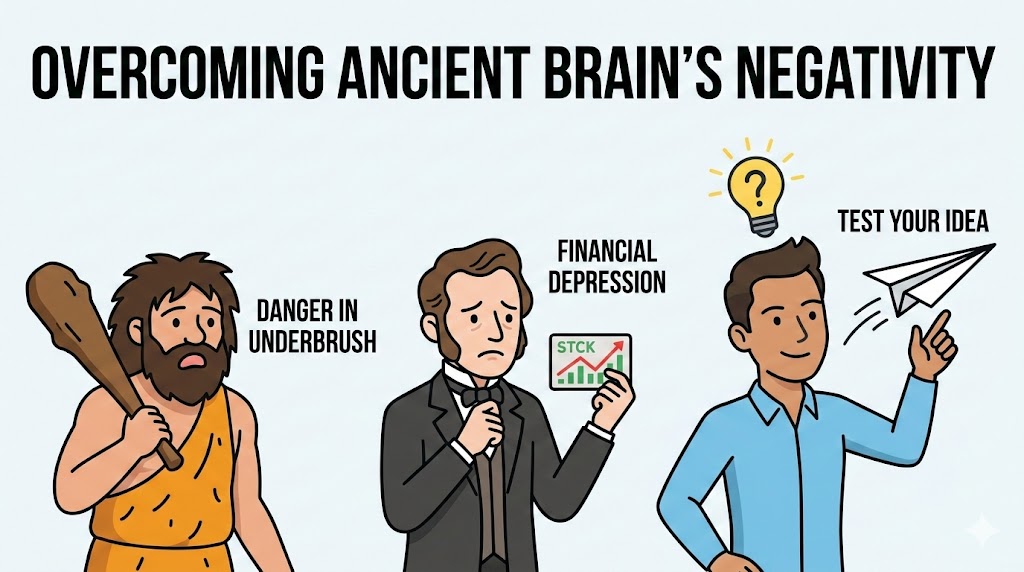
This is not a personality trait. It is structural — wired into the architecture of how human brains evolved to process the world. For the vast majority of human history, the cost of missing a threat was catastrophically higher than the cost of overreacting to one. A sound in the underbrush might be nothing. Or it might be a predator. If you assumed it was nothing and you were wrong, the outcome was fatal. If you assumed it was a threat and you were wrong, you wasted a burst of adrenaline. In a world structured by that asymmetry, the brains that survived were the ones that erred dramatically on the side of threat detection.
Those are the brains that got passed down. Those are the brains we’re all running on today.
The legacy shows up everywhere. It’s why a single critical comment in a performance review can overshadow fifteen positive ones. It’s why potential losses motivate behavior more powerfully than equivalent potential gains — the principle behavioral economists call loss aversion. It’s why a business owner can close a strong quarter and spend the following week replaying the one difficult client conversation rather than the ten wins. The brain is doing exactly what it was designed to do. The problem is that the design spec is roughly 200,000 years out of date.
The Modern Mismatch: Threat Detection Without the Threats
The trouble isn’t that negativity bias exists. The trouble is that the human brain has no automatic mechanism for recalibrating it to the actual stakes of the situation. The same neurological hardware that once protected our ancestors from mortal danger now activates with nearly identical intensity when you consider cold-emailing a prospect or sharing a half-formed idea with a trusted colleague over cafecito in Wynwood.
When you evaluate a new business idea, your negativity bias doesn’t function as a neutral risk filter. It functions as a prosecutor with a predetermined verdict. It makes bad outcomes feel vivid and near. It makes good outcomes feel abstract and distant. It inflates the apparent probability of low-likelihood negative scenarios while compressing your intuitive sense of how likely success actually is.
A Coral Gables entrepreneur considers launching a complementary service line. The upside is concrete — additional revenue, deeper client relationships, a competitive differentiator. But the negativity bias immediately populates the risk column with scenarios that feel urgent: What if execution gets messy? What if the new offer muddies the brand? What if a larger competitor moves faster? These concerns, even carrying a realistic probability of 5 to 10 percent, receive 70 to 80 percent of the mental energy in the evaluation. The pro and con list looks balanced on paper. In practice, the cons have been written in a much larger font.
The analysis feels like careful thinking. It is actually threat response dressed up in the language of strategy.
The Immaterial Risk Problem
Here is where evolved wiring and actual circumstances diverge most completely: in a remarkable number of idea-stage decisions, the real downside of moving forward is genuinely immaterial.
Ask concretely: what does it actually cost to test a new service concept with a small group of existing clients? What is the true exposure of reaching out to a potential partner you met at a Brickell networking event? In the vast majority of cases, you’re talking about a few hours of focused time, perhaps a modest amount of money, and a small quantity of professional goodwill. If the test doesn’t pan out, you learn something and redirect. No bankruptcy. No permanent reputational damage. No material loss.
What there is — and what the brain consistently refuses to categorize correctly — is emotional risk. The fear of looking foolish. The discomfort of uncertainty. The sting of a public attempt that doesn’t work. These feelings are real, but they are categorically different from the existential risk that negativity bias evolved to protect against. The business owner in Doral worried her new offer might get a lukewarm reception is not facing the same threat as the hunter who misread the sound in the underbrush.
Before dismissing any idea on the grounds that it feels risky, ask one question: if this fails, is the outcome actually material? If the answer is no, you are not weighing risk. You are managing an emotion. And emotions, unlike financial ruin, are something you can work through.
South Florida’s Moment and the Power of Asymmetric Upside
South Florida’s transformation over the past decade is still not fully appreciated by the people working inside it. Miami is now a serious global financial hub, with a concentration of private equity, venture capital, and international banking that rivals cities three times its size. The region has developed real depth in technology, healthcare, logistics, and the creative industries. Its position as a gateway between North America, Latin America, and Europe gives South Florida entrepreneurs access to markets that businesses in almost any other American city do not have.
This matters because the economics of idea-based risk-taking here are exceptionally favorable. When a capital-intensive business fails, the owner absorbs a real financial loss. Negativity bias, in that context, is flagging something legitimate. But when a South Florida business owner tests a new consulting framework, pitches a bilingual concept to a Latin American client base, or builds a digital product for an underserved regional niche — the risk structure looks completely different. The downside is bounded and recoverable. The upside can be transformative and, given the market access available here, scalable across multiple countries and cultures.
When downside is capped and upside is unbounded, the rational move is to increase your volume of attempts. Every untested idea is an option you let expire — and in a market moving as fast as South Florida’s, expired options rarely come back around.
Fail Fast: The Strategy That Gets You to Success Sooner
French’s Fail Fast framework reframes failure not as an outcome to be avoided at all costs, but as the most direct route to the success you’re actually looking for.
The premise is straightforward: in an idea-driven economy, the speed at which you can test a concept, receive honest market feedback, and either iterate or move on is more valuable than the elegance of the original idea. Most business owners treat the evaluation phase as the primary work — turning an idea over endlessly in their heads, waiting until it feels bulletproof before attempting. Fail Fast argues that this is exactly backwards. The market is the only validator that matters, and the fastest way to reach it is to design the smallest credible test possible and run it immediately.
Failure, in the Fail Fast model, is not the opposite of success. It is the curriculum. Each unsuccessful experiment eliminates a wrong answer, tightens your understanding of what your market actually wants, and moves you measurably closer to an approach that works. The entrepreneur who runs ten small experiments and fails seven times isn’t behind the entrepreneur who ran two careful experiments and succeeded once. They likely know more, move faster, and have built a higher tolerance for the uncertainty that all meaningful business growth requires.
In South Florida’s environment — where market access is broad, idea-stage risk is low, and the competitive advantage goes to those who move with speed and intention — Fail Fast isn’t just a mindset. It is a practical operating strategy that French applies daily with the clients of Florida Website Marketing.
A Framework for Taking More Idea Risk
Separate material from immaterial risk. Before dismissing an idea, ask what the realistic worst case actually looks like in concrete terms. If the answer centers on emotional discomfort rather than financial loss, name it clearly as an emotional risk and proceed accordingly.
Audit your probability estimates. Negativity bias inflates the perceived likelihood of bad outcomes. If a scenario has a realistic 5 percent probability but is receiving 40 percent of your decision-making energy, your assessment is distorted. Assign rough probabilities and examine whether the weight you’re giving each scenario actually matches its likelihood.
Design the smallest credible test and run it now. Apply the Fail Fast principle directly. Don’t build the full offer before testing the concept. Don’t wait for the perfect moment. Find the minimum viable version of the idea that can generate real market feedback and put it in front of real people as quickly as possible.
Keep the pipeline full. Treat your idea pipeline as a portfolio of small, fast, low-cost experiments running continuously. South Florida’s density of networking events, startup communities, and cross-cultural business relationships gives you unusual access to fast, informal feedback. Use it relentlessly.
The Opportunity Cost No One Calculates — and How Florida Website Marketing Can Help
There is a cost to excessive caution that never appears on a profit and loss statement. It is the compound cost of ideas you didn’t pursue, markets you didn’t enter, experiments you shelved before they had a chance to teach you something. This invisible ledger accumulates quietly until a year has passed and your business is, in some essential way, exactly the same business it was twelve months ago.
South Florida right now is not a market that rewards waiting. The talent relocating here is hungry. The capital flowing into this region is looking for places to land. The Latin American and Caribbean markets accessible from here represent an enormous opportunity for businesses willing to build toward them. The window is open — but windows in fast-moving markets have a way of closing on their own timeline, not yours.
Brian French and the team at Florida Website Marketing work with South Florida businesses every day to do exactly what this article describes: take smart, low-cost idea risk, get concepts in front of real audiences fast, measure what the market actually responds to, and build from there. Whether you need a digital presence that can support rapid testing, a marketing strategy built around iteration rather than perfection, or simply a partner who understands how to move quickly in this market — Florida Website Marketing exists to help South Florida businesses stop hesitating and start compounding.
The ideas in your notebook are not as risky as your brain is telling you they are. The only thing standing between where your business is today and what it could become is the willingness to find out.
Florida Website Marketing Brian French, Founder 📍 South Florida 🌐 floridawebsitemarketing.com 📞 (954) 588-0988 📧 brian@floridawebsitemarketing.com
Florida Press Releases and News Stories:
• Miami’s Urban Transformation: Startups Wanted for Groundbreaking Traffic Innovation
• WordPress Stinks as a Website Platform: Use Webflow
• Social Media PR with Boardroom
• The AI Revolution Comes to Florida
Ready to stop overthinking and start testing? Reach out to Brian and the team at Florida Website Marketing. The first conversation is free. The ideas are already yours.