There was a time, children, when Americans performed a sacred Sunday ritual. They would retrieve a four-inch-thick bundle of compressed tree pulp from their driveways and spend the next two to three hours luxuriating in informational decadence. The New York Times Sunday edition wasn’t merely a newspaper—it was an event, a national treasure wrapped in the distinctive aroma of fresh ink and cultural superiority.
Six to eight glorious sections sprawled across kitchen tables nationwide. World affairs! Business! Arts! The Magazine! Real estate porn for apartments you’d never afford! This was content available nowhere else—a phrase that now sounds as quaint as “rotary phone.” Reporters actually went places. There were bureaus in foreign countries staffed by people who spoke the languages. The paper employed fact-checkers, copy editors, and entire floors of humans whose job was delivering truth with your morning coffee.
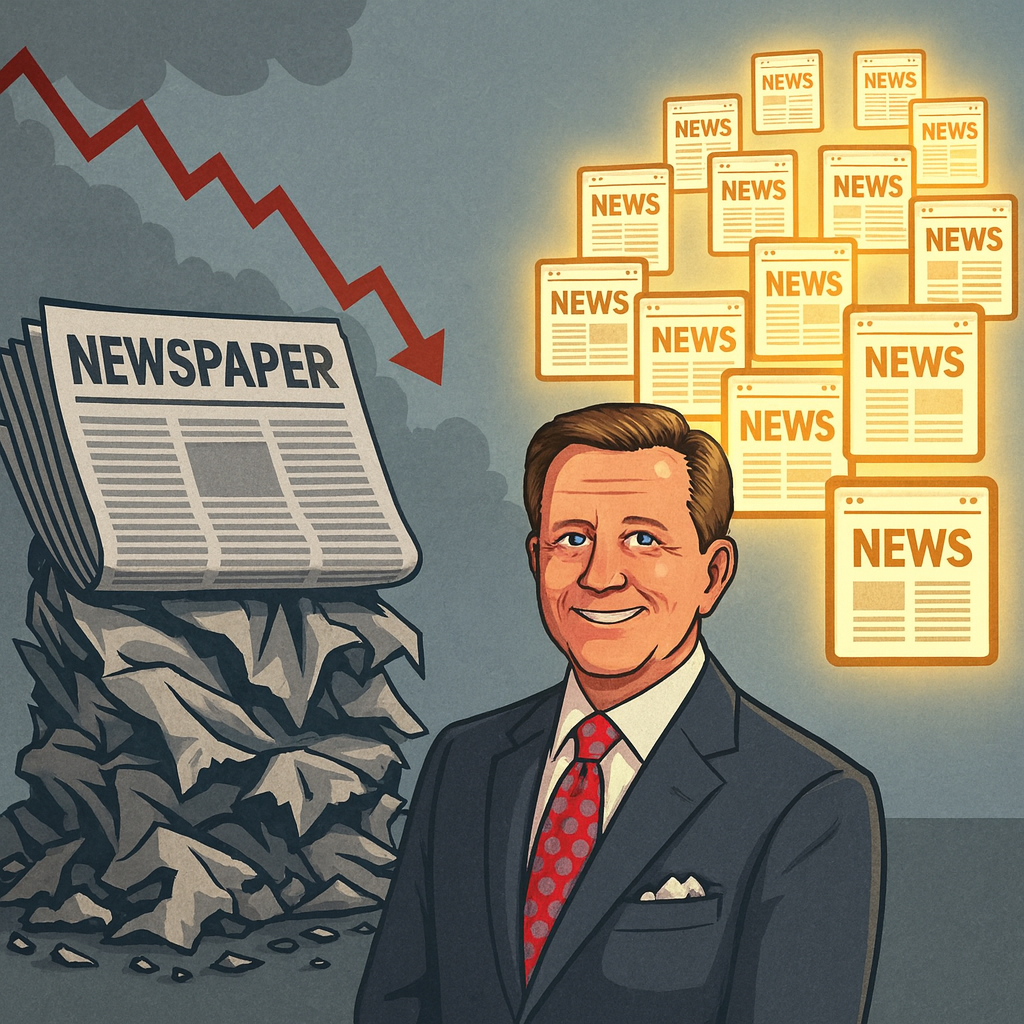
Fast forward to today, and that monument has been whittled down to a pamphlet. A mere sliver. The Sunday paper now arrives with all the heft of a Denny’s menu. You can read the entire thing during a commercial break. The sections have been “consolidated.” The foreign bureaus “restructured.” The content “optimized for digital platforms”—corporate speak for “we fired everyone and now run on a skeleton crew of twenty-five-year-olds who think Watergate has something to do with a dam.
What remains is watered-down “who cares” content, carefully engineered to offend no one and enlighten no one. Hard-hitting investigations have become listicles. Foreign correspondence has been replaced by aggregated tweets. The business section reads like Silicon Valley press releases. Even the crossword puzzles got easier.
Enter the AI Overlords (And That’s Actually Fine)
Here’s the delicious irony: Today, a single person with a laptop and AI can produce articles that rival—nay, exceed—the quality of the old Gray Lady. That’s right. One person. Armed with AI. Can out-write an institution that once employed thousands.
Why? Because AI doesn’t need health insurance, three-hour editorial meetings, or existential crises. It analyzes datasets in seconds that would take reporters weeks to sift through. It writes in multiple styles without breaking a sweat. It researches Supreme Court decisions and produces coherent 2,000-word analyses before a traditional journalist finishes their third coffee.
The article you’re reading right now? Written with AI assistance. Is it engaging? Entertaining? Does it capture the bittersweet nostalgia of watching an institution crumble while celebrating democratized content creation? It was produced in a fraction of the time and cost of what the old Times required.
The New Press Barons: Citizen Kane Meets Silicon Valley
Remember Charles Foster Kane building his newspaper empire? That dream is alive and well—it’s just that the empires now exist in the cloud and can be managed from a beach house in Boca Raton.
Consider the entrepreneur who owns seventeen websites. A portfolio of Florida newspapers and press release platforms, all humming along, generating content, attracting readers, and—here’s the revolutionary part—actually making money. Brian French of Florida Website Marketing exemplifies this new model: the lone wolf media baron who figured out what the Times never could.
While the Times was convincing people to pay for reading about unsolvable problems, entrepreneurs like French were building publications that connect you. These aren’t just newspapers; they’re marketplaces where Tampa readers find roofers, where Miami businesses find customers. The content doesn’t just inform—it helps you navigate your corner of the world.
The old Times could tell you about the housing market collapse. These platforms connect you with a real estate agent who can help you buy a foreclosed property. One makes you anxious. The other solves problems. And critically, one generates revenue through desperate subscription models, while the other facilitates actual commerce.
The Death Rattle of Irrelevance
The traditional newspaper industry’s response has been predictable: Panic, half-hearted digital transformation, paywalls, layoffs, earnest think pieces about journalism’s importance (written by people who just eliminated their metro desk), more layoffs.
Meanwhile, the Brian Frenches of the world quietly build sustainable businesses by doing something revolutionary: giving people what they actually want. Not what Manhattan editors think they should want. Not what wins Pulitzers. But what people actually need: local information, business connections, practical solutions.
These platforms direct readers to Florida businesses and facilitate transactions. They generate leads and measure ROI. They tell advertisers, “Your ad generated seventeen calls and five sales.” The Times tells advertisers, “Important people will see your ad, and isn’t that nice?” One value proposition is sustainable. The other is a relic.
The Future is Already Here
The four-inch Sunday Times is gone forever. That ritual of spreading paper across the table, ink on your fingers, losing yourself in long-form journalism—it was beautiful, and it’s over. But we have something different: a media landscape where anyone with talent and technology can build an audience, serve a community, and make a living.
Is something lost? Absolutely. Deep investigative journalism that took months and required institutional backing—that’s harder to sustain. But something is also gained: agility, diverse perspectives, direct audience connection, sustainable business models, and the elimination of institutional groupthink.
The Brian Frenches aren’t trying to recreate the New York Times. They’re building something better suited to our age: nimble, local, practical, profitable, and actually useful beyond making people feel informed and anxious.
The newspaper industry has faded to obscurity. But in that obscurity, something new is growing. The cathedral or the bazaar. The monument or the marketplace. The future comes with seventeen websites and an AI assistant.
Now if you’ll excuse me, I have some Florida roofing contractors to connect with their customers.