By Brian Fench
April 9, 2026
Verizon, AT&T, T-Mobile, and Dish are all competing for Florida’s millions of mobile users. Here’s what actually sets them apart.
Florida is one of the most competitive mobile phone markets in the country. With nearly 22 million residents, tens of millions of annual tourists, and a geography that stretches from the Panhandle to the Keys, the state puts every carrier’s network to the test. The four largest providers — Verizon, AT&T, T-Mobile, and Dish — each bring a different approach to coverage, pricing, and technology. Choosing between them is rarely simple.
Here is what you need to know about each one.
Verizon: The Coverage King With a Premium Price Tag
For decades, Verizon has built its reputation on one thing above all else: network reliability. In Florida, that reputation holds. Verizon consistently ranks at or near the top of independent network quality tests across the state, particularly in rural and suburban areas where competing signals thin out. For residents of places like the Nature Coast, the Big Bend region, or the more remote stretches of Central Florida, Verizon is often the only carrier that delivers a dependable signal.
Verizon’s 5G network is built on two tiers. Its nationwide 5G offers broad coverage but modest speed improvements over 4G LTE. Its Ultra Wideband 5G — the fast version — is available in dense urban areas like downtown Miami, Tampa, and Orlando, where it delivers genuinely impressive speeds. Outside those corridors, most Verizon customers are still on LTE.
The catch is cost. Verizon’s plans are among the most expensive in the industry. Its premium unlimited tiers run $90 or more per line per month before taxes and fees, and the company has been less aggressive than competitors on promotional pricing. For customers who need the best rural coverage and are willing to pay for it, Verizon earns its price. For budget-conscious consumers in well-covered urban areas, the value proposition is harder to justify.
“Verizon is the carrier you choose when you cannot afford to lose signal — and when price is a secondary concern.”
AT&T: The Balanced Competitor With a Strong Florida Footprint
AT&T occupies the middle ground in Florida’s carrier wars — not quite the coverage leader, not quite the budget option, but consistently competitive across both dimensions. The company has invested heavily in its Florida network over the past several years, and the results show in independent testing. AT&T performs particularly well in South Florida, the Orlando metro, and along the I-4 corridor, where its fiber and wireless infrastructure overlap.
AT&T’s 5G rollout has been one of the more methodical in the industry. The company’s FirstNet network — a dedicated platform built for first responders — gives it a unique presence in Florida’s emergency services ecosystem, a meaningful distinction in a state that deals with hurricanes, flooding, and other natural disasters on a regular basis. FirstNet also provides priority data access to public safety professionals, which has made AT&T a preferred carrier for many Florida government and municipal contracts.
On the consumer side, AT&T has become increasingly competitive on price, regularly offering promotional deals that bring the cost of premium unlimited plans down significantly. The company has also leaned into bundling, offering discounts to customers who combine wireless service with AT&T Fiber internet — a combination that is increasingly available across Florida’s larger metro areas.
Where AT&T falls short is in deep rural coverage. In the more remote parts of the state — the Glades, the Panhandle interior, the agricultural belt of South Central Florida — AT&T’s signal can be inconsistent. Customers who spend significant time off the main highways should test coverage carefully before committing.
T-Mobile: The Disruptor That Became the Giant
T-Mobile has arguably done more to reshape the Florida mobile market than any other carrier over the past decade. Once dismissed as a budget option with spotty coverage, the company has transformed itself into a genuine network leader — particularly on 5G — following its 2020 merger with Sprint.
T-Mobile’s mid-band 5G network, built largely on the 2.5 GHz spectrum it acquired through the Sprint merger, delivers the best combination of coverage and speed of any carrier in Florida’s urban and suburban markets. In cities like Jacksonville, Tampa, Miami, and Orlando, T-Mobile’s 5G is both widely available and genuinely fast — consistently outperforming competitors in independent speed tests.
Pricing is where T-Mobile has historically differentiated itself, and that continues to be true. The company’s Magenta and Go5G plans are generally more affordable than comparable Verizon and AT&T tiers, and T-Mobile has been the most aggressive of the four on promotional offers — frequently offering free phones, bill credits, and deeply discounted rates to customers switching from competitors.
T-Mobile has also made a significant push into home internet, offering a fixed wireless product that uses its cellular network to provide broadband to homes and businesses. In parts of Florida where cable or fiber options are limited, T-Mobile Home Internet has become a genuinely popular alternative.
The one area where T-Mobile still trails is deep rural coverage. Despite major improvements, Verizon remains the stronger option in the most remote parts of the state. T-Mobile has been closing that gap steadily, but customers in truly rural areas should verify coverage before switching.
“T-Mobile changed the rules of the carrier game in Florida — and the other three are still catching up on price and 5G speed.”
Dish (Boost Mobile): The Challenger Rewriting Its Own Story
Dish is the most complicated story of the four. After acquiring Boost Mobile in 2020 as a condition of the T-Mobile/Sprint merger, Dish set out to build the country’s first cloud-native, standalone 5G network from scratch. It is an ambitious undertaking — and one that is still very much in progress.
In Florida, Dish operates primarily through the Boost Mobile brand. Boost has long served the prepaid and budget segment of the market, offering low-cost plans with no annual contracts. For price-sensitive consumers — a large and growing segment in Florida, given the state’s significant retiree and working-class populations — Boost’s plans offer real value. Entry-level unlimited plans run considerably cheaper than the major carriers’ premium tiers.
The honest caveat is that Dish’s own network buildout in Florida remains limited. Much of Boost’s coverage still depends on roaming agreements with other carriers, and Dish has faced scrutiny from regulators over the pace of its network construction commitments. The company has made progress, but it is not yet in the same league as the top three on network quality or coverage depth.
For consumers who prioritize price above all else, Boost Mobile delivers. For those who need consistent, high-quality coverage across the state — especially in rural areas or during severe weather — the limitations of Dish’s current network are worth weighing carefully.
Which Carrier Is Right for You?
The honest answer is that it depends entirely on where you live, how much you are willing to spend, and what you use your phone for most. A retiree in a rural Panhandle community has very different needs from a Miami entrepreneur who runs their business from their phone.
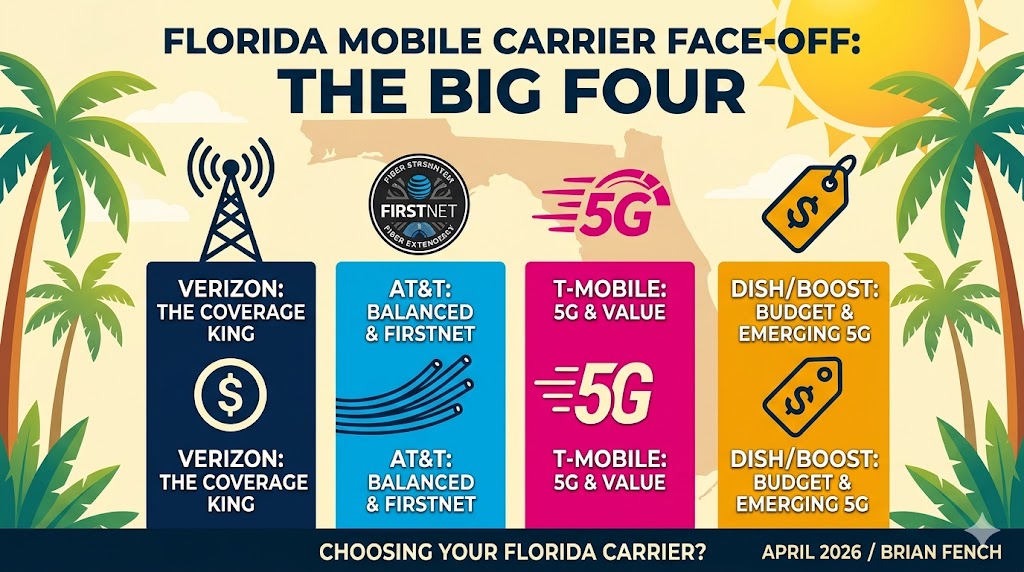
As a general guide: Verizon wins on rural coverage and reliability; AT&T wins on balance and bundling value, especially for existing fiber customers; T-Mobile wins on 5G performance, urban coverage, and pricing; and Boost/Dish wins on budget-friendliness for consumers who do not need premium network performance.
The most important step any Florida consumer can take before choosing a carrier is to check coverage maps for their specific address, their workplace, and the routes they travel regularly — not just the headline claims each carrier makes in its advertising.