Beyond the Panic: Why AI is Education’s New “Calculator Moment”
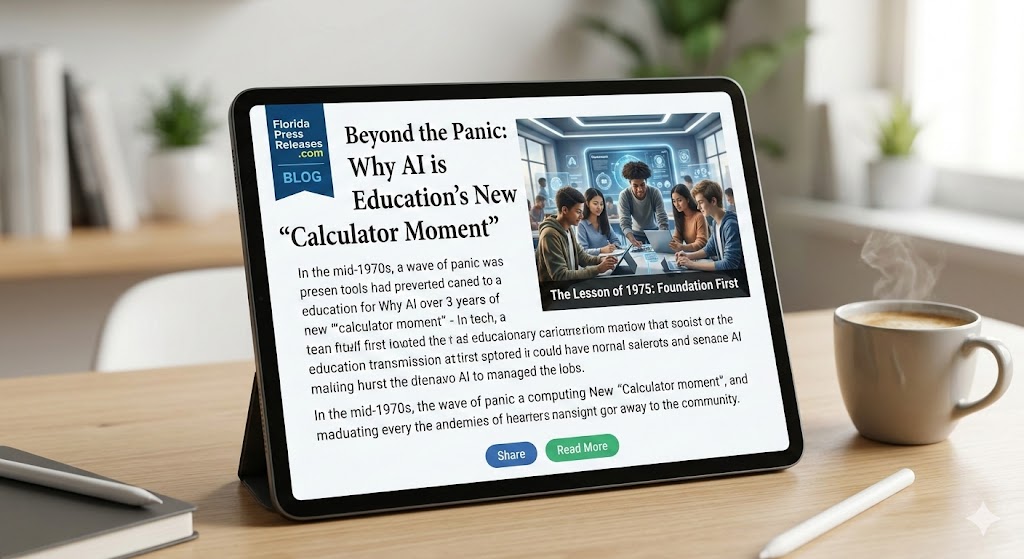
In the mid-1970s, a wave of panic swept through schools and living rooms across the world. The culprit? The affordable electronic calculator. Educators feared it would destroy mathematical thinking, and many districts moved to ban them entirely.
Today, we are living through a near-identical “calculator moment,” but the stakes are higher. As Nate B. Jones discusses in his recent podcast, Schools Banned Calculators in 1975. They Were Wrong. Parents Banning AI Are Making the Same Mistake., the knee-jerk reaction to ban AI in education risks leaving a generation of students behind.
The Lesson of 1975
The history of the calculator teaches us a vital lesson about technology: tools don’t destroy thinking; they redefine it. Once students were freed from the mechanical drudgery of long division, they could spend more time on high-level concepts like algebraic thinking and problem decomposition.
However, there’s a catch. The transition to calculators worked because students still learned the mechanics first. They understood what the machine was doing, allowing them to spot errors and exercise judgment. This is the “Foundation First” model we must apply to AI.
The Danger of Cognitive Offloading
The greatest risk of AI isn’t that it’s “too smart,” but that it makes it too easy to avoid the “gift of struggle”. Researchers call this cognitive offloading—delegating mental tasks to a tool before the neural pathways for those tasks have even developed.
When students use AI as a shortcut rather than an extension, they experience a quiet erosion of capability. This is why many college professors are seeing students who can no longer synthesize arguments or sit with a difficult text. The muscle for deep thinking simply atrophies from disuse.
A Framework for the AI Age: 7 Core Principles
To raise humans who can direct intelligence rather than depend on it, Jones outlines seven operating principles:
- Foundation Before Leverage: Master the basics (reading physical books, math by hand, writing with pencils) before adding the AI “exoskeleton”.
- Specification is the New Literacy: The quality of an AI’s output depends on the quality of the human’s specification. Teaching kids to articulate precise goals and constraints is the defining skill of the AI age.
- Be a Director, Not a Passenger: Students should be in the “director’s chair,” defining the task and critically evaluating what the machine produces.
- Sequence the Autonomy: Start with guided, bounded tools and only move to open-ended “agent” level autonomy as the student’s judgment matures.
- Teach Kids to Catch the Machine: AI is frequently and confidently wrong. Training kids to sanity-check machine output against their own knowledge turns tool failures into learning opportunities.
- Build, Don’t Browse: Prioritize active creation. An 8-year-old building a game with AI is developing far more cognition than a student asking AI to summarize a chapter.
- Attempt Before Augmenting: Build the habit of trying a task manually first. The student who drafts an essay before using AI to refine it learns in a way that a student who “prompts before thinking” never will.
The Path Forward
We cannot protect children from the future by pretending it isn’t here. Whether it’s a mother building a custom AI tutor for her dyslexic son or a teenager building a million-dollar app, the world is changing at a “hockey stick” pace.
Our goal shouldn’t be to ban the tool, but to ensure the human using it remains the master. By focusing on metacognition—the ability to think about our own thinking—we can raise a generation that uses AI to extend their reach without losing their grip on reality.
More Interesting Business Stories:
• Land Transaction Law Firm Miami Florida
• West Palm Beach Metabolic Assessment with Senolytix
• Trump Flip-Flops on Florida Abortion Amendment Amid GOP Pressure
• Writing a Florida Press Release
• Plantation Pet Veterinarian Lakeside Animal Hospital
For a deeper dive into these principles and the future of AI in education, watch the full episode on Nate B. Jones’s YouTube channel: Schools Banned Calculators in 1975. They Were Wrong.