By Brian French
March 31, 2026
Florida Business Today | Statewide Economic Report | March 2026 Sources: U.S. Bureau of Economic Analysis · Federal Reserve Bank of St. Louis (FRED) · Florida TaxWatch · UCF Institute for Economic Forecasting · Florida Chamber Foundation · Florida Legislature Office of Economic and Demographic Research
Florida Has Arrived on the World Stage
From Pensacola to Key West, from Jacksonville to Naples, something historic has taken root across the entire state of Florida. The economy that generations of Floridians built — through hurricanes, recessions, booms, and transformation — has grown into one of the most powerful economic engines on the planet.
This is not regional hyperbole. This is documented fact.
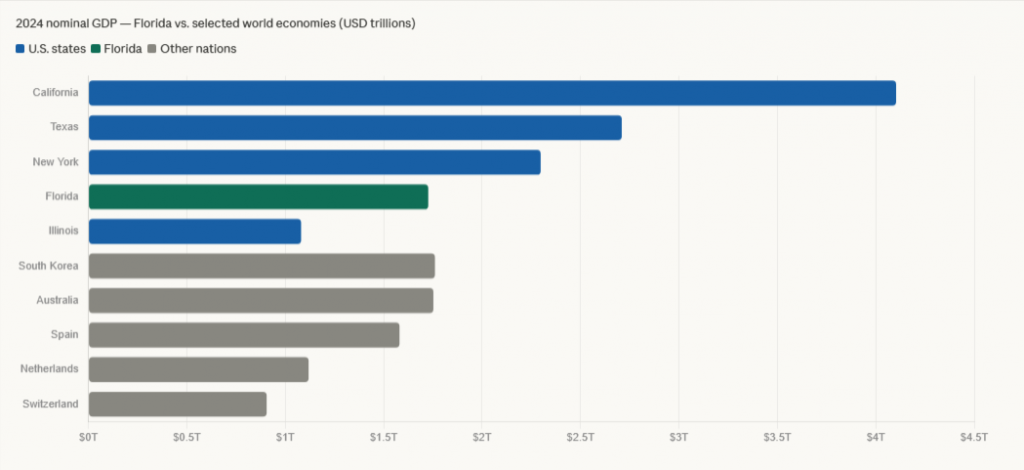
Florida’s economy is the fourth-largest in the United States, with a $1.726 trillion gross state product as of 2024. If Florida were a sovereign nation, it would rank as the world’s 15th-largest economy by nominal GDP — ahead of Spain and behind South Korea.
Every business in Florida — from the Tampa Bay tech startup to the Orlando hospitality group to the Jacksonville logistics company to the Miami hedge fund — is operating inside a market of extraordinary scale and global consequence. Florida is responsible for 5.82% of the United States’ approximately $28 trillion gross domestic product. That share grows every year. And the businesses, firms, and entrepreneurs who understand this moment and invest in it will define the next chapter of Florida’s story.
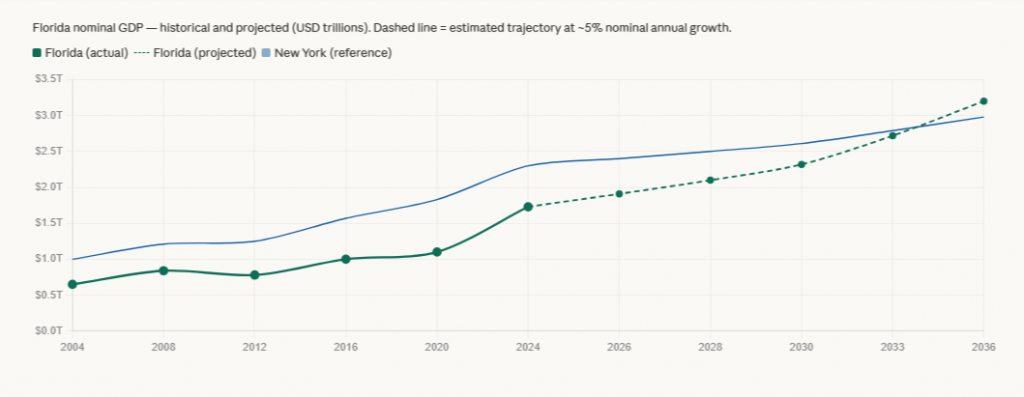
Florida’s Rank Among the World’s Largest EconomiesThe three states ahead of Florida are California ($4.103 trillion), Texas ($2.709 trillion), and New York ($2.297 trillion). The gap between Florida and New York sits at roughly $570 billion today — and it is closing steadily. At current growth differentials, Florida could realistically challenge New York for the No. 3 spot among U.S. state economies by the mid-to-late 2030s. That trajectory is not a forecast to file away. It is a business opportunity to act on now.
Florida’s real (inflation-adjusted) GDP reached approximately $1.3 trillion in 2024 — up 3.6% from 2023 and the highest on record. The real estate, rental, and leasing industry contributed the most to Florida’s GDP at $265.5 billion, followed by professional and business services at $208.3 billion and educational services, health care, and social assistance at $126.2 billion.
Two Decades of Growth That Built This Economy
Florida’s rise to global economic significance was earned over twenty years of compounding structural advantages — and understanding how it happened helps every Florida business think more clearly about where it is headed.
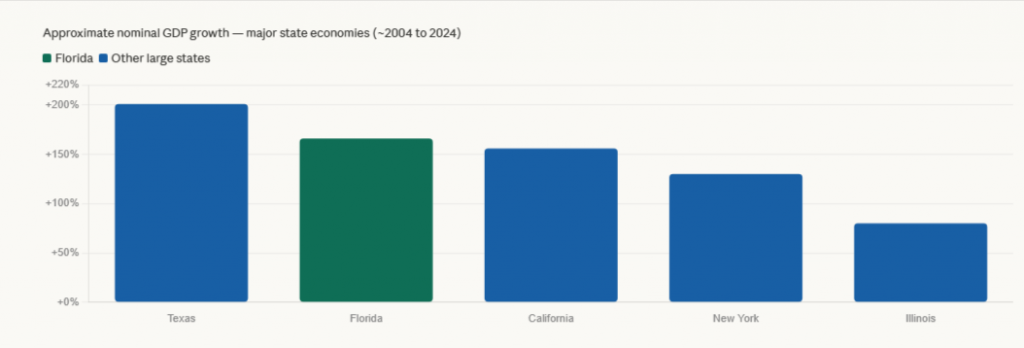
In the early 2000s, Florida’s nominal GSP was approximately $650 billion, placing the state fifth in the nation. By 2024, FRED data from the U.S. Bureau of Economic Analysis places Florida’s nominal GSP at $1,726,709.9 million — representing roughly 166% nominal growth over two decades. No income tax. A business-friendly regulatory environment. Relentless population growth. A deliberate diversification strategy that moved Florida far beyond tourism and retirement. All of it compounded, year after year, into the economy Florida has today.
Florida’s nominal GDP surged to 8.3% growth in Fiscal Year 2021–22, exceeding the prior peak growth rate of 6.6% recorded in Fiscal Year 2004–05. The state then expanded by a still-robust 4.9% in Fiscal Year 2022–23 and 3.7% in Fiscal Year 2023–24.
From 2021 to 2022 alone, Florida’s real GDP grew at 4.6% — the fastest of any large state that year. For all of 2023, Florida’s GDP growth rate was double the national pace of 2.5%. California, New York, Pennsylvania, and Illinois all trailed the national average that same year.
Over the longer term, Florida achieved approximately 113% real GDP growth from 1990 to 2024, outpacing the national average rate of GDP growth. Only Texas — with 128% long-term growth — outpaced Florida among the largest state economies, while Florida (4.6%) and Texas (3.9%) both grew faster than California since 2020.
How Florida’s Growth Compares to Every Other Large State—
The People and Companies Fueling Florida’s Next Chapter
What makes Florida’s economic story especially compelling — and especially relevant for every business in the state — is who is arriving here and what they are building.
In 2024 alone, over 700 people moved to Florida each day. The state remains one of only nine without a personal income tax, making it especially attractive to high earners, retirees, and remote workers. Florida Chamber of Commerce data shows that migration into Florida grew at an average of 3.7% per year over the past decade, while migration out remained essentially flat — growing just 1.5% per year on average.
Florida dominates national migration rankings, home to eight of the top 10 U.S. growth cities and 12 of the top 25 per U-Haul’s 2025 Growth Index.
These are not passive arrivals. They are executives, investors, entrepreneurs, and professionals from New York, California, Chicago, London, São Paulo, and Bogotá — people building companies, deploying capital, and growing businesses across every corner of the state. From Tallahassee to Fort Lauderdale, from Tampa Bay to the Space Coast, the people driving Florida’s economy forward are increasingly world-class in their ambitions and expectations.
The corporate migration story is equally powerful. Major companies that relocated or significantly expanded operations in South Florida during 2024 and 2025 include Microsoft’s Latin America headquarters in Miami’s Brickell district, Citadel’s continued expansion following its headquarters relocation to Miami, Amazon’s corporate and technology expansion in Miami’s Wynwood district, and Varonis relocating its global headquarters from New York to Miami.
In 2025 alone, nearly 698,000 new businesses were formed in Florida, and roughly 67,000 new business filings were recorded in January 2026 alone. Florida leads the nation in business relocations, with more than 500 net business relocations in the most recent Florida Chamber Foundation analysis.
Nearly 700,000 new businesses in a single year. Think about what that means for every professional services firm, marketing agency, technology provider, financial adviser, and logistics company in the state. The client pipeline is not theoretical. It is arriving every single quarter.
Tourism: Florida’s $131 Billion Global Platform
Nearly 143 million tourists visited Florida in 2024 — a record. A 2023 impact study estimated 156.9 million visitors spent $131 billion — an average of $359 million per day — directly supporting 2.1 million jobs and $76.4 billion in employee wages. Thanks to tourism revenue, every Florida household saves an estimated $1,910 per year on state and local taxes.
An economy that attracts 143 million visitors a year is also a global media platform. International journalists, foreign investors, multinational brands, and global business press all operate in and around Florida’s major markets. For Florida businesses in hospitality, real estate, retail, entertainment, food and beverage, and professional services, the reach of this visitor economy extends the potential audience for their stories, their brands, and their services far beyond state lines.
The Industries Writing Florida’s Future
Florida’s economy spans international banking, aerospace and defense, biomedical and life sciences, commercial space travel, and a rapidly expanding technology sector — layered atop its enduring strengths in real estate, construction, agriculture, and tourism.
The Florida Chamber Foundation reports Florida leads the nation as the No. 1 state for new business start-ups, the No. 1 state for manufacturing job growth, and the No. 1 state for net income migration.
Every one of these sectors generates high-value, sophisticated business needs — for capital, for talent, for technology, for professional services, and critically, for communications and digital visibility. The businesses that serve these growing sectors well — and that position themselves to be found by the companies arriving every week — will capture an outsized share of Florida’s growth.
The Digital Imperative: SEO, AI Overviews, AEO, and Google Business Profile
Competing for business in a $1.7 trillion economy requires more than a great product or service. It requires being findable — in Google, in AI-powered search, and in the local discovery tools that executives, decision-makers, and consumers across the state use every single day.
Three forces are reshaping digital visibility right now, and every Florida business needs to understand them.
Search Engine Optimization (SEO) is the foundation — ensuring that when a potential customer, client, or partner searches for what your business offers anywhere in Florida, your company appears where the decision gets made: at the top of organic results. In a state growing as fast as this one, with new competitors arriving constantly and nearly 700,000 new businesses forming annually, SEO is not a one-time project. It is a continuous competitive discipline.
AI Overview and Answer Engine Optimization (AEO) is the frontier that is redefining search right now. Google’s AI Overviews — the AI-generated summaries that now appear above traditional results — are increasingly the first and only answer that a searcher sees. AI assistants including ChatGPT, Gemini, Perplexity, and Claude are being used by executives and decision-makers across Florida’s booming business community to find vendors, vet competitors, and identify service providers. If your business is not structured to be cited and recommended by these AI systems, you are invisible to a fast-growing segment of the most valuable prospects in the state.
Google Business Profile optimization anchors the local and hyperlocal search that captures in-market buyers in every Florida city and community — from Panama City to Homestead, from St. Augustine to Sarasota.
These three disciplines deliver maximum value when they operate as a unified, integrated platform — not as separate vendor relationships, but as a coordinated system where SEO authority feeds AI citation, AI visibility amplifies brand credibility, and optimized local profiles convert searchers into real conversations.
Florida Website Marketing’s News & Press Release Platform delivers exactly that kind of integrated, purpose-built solution for Florida businesses. By combining news distribution, authoritative SEO link building, press release marketing, AI Overview optimization, AEO, and Google Business Profile management into a single platform built specifically for the Florida market, it gives businesses across the state a turnkey digital visibility engine that works continuously — long after any individual campaign ends. For companies serious about competing in this economy, it is a strategic asset, not a marketing line item. Call (813) 409-4683 or visit floridawebsitemarketing.com/news-links.
For Florida businesses that need the full strategic communications picture — earned media, brand positioning, crisis management, social media, content, and SEO working together — BoardroomPR has been the state’s leading full-service public relations and digital marketing firm for over three decades. Ranked #4 in Florida and #87 nationally by O’Dwyer’s, and recognized across specialties including real estate, law, banking and finance, hospitality, and fashion, BoardroomPR tailors every strategy to the specific goals, industry, and audience of each client — delivering media relations, crisis management, content creation, social media strategy, and SEO as an integrated campaign, not a collection of services. With offices in Fort Lauderdale, Miami, Tampa, Orlando, West Palm Beach, and Naples, BoardroomPR is built for Florida at scale. Call (954) 370-8999 or visit boardroompr.com.
Where Florida Is Headed: The Projections Every Business Leader Should Know
The forward trajectory of Florida’s economy is not a reason to wait. It is a reason to move.
The UCF Institute for Economic Forecasting projects Florida’s nominal GDP will exceed $2.06 trillion in 2028, with real GDP at $1.45 trillion. Real Gross State Product is projected to grow at an average annual rate of 2.1% from 2025 through 2028.
Florida TaxWatch projects the state’s population will increase by about 1.4 million people — from 23.4 million to 24.8 million — between 2025 and 2030, and the number of employed Floridians is projected to grow from approximately 10 million to 10.9 million over the same period.
Florida’s real GDP growth is expected to outpace the U.S. average through 2030, while unemployment is projected to remain near or below the national average.
The Florida Chamber Foundation has set a long-term goal of making Florida a top-10 global economy by 2030, having already surpassed Spain and standing just $25.5 billion behind Australia as of late 2025.—
Eyes Open: The Headwinds Florida Is Managing
A credible picture of Florida’s future includes honest acknowledgment of the pressures the state is navigating — because the businesses best equipped to grow through them are the ones who understand them clearly.
Florida’s net domestic migration slowed sharply to about 23,000 in 2025 compared to roughly 314,000 in 2022, as housing costs have risen and the affordability gap with high-cost markets has narrowed. The pace of growth is moderating to a more sustainable level — which is a healthy normalization after the extraordinary post-pandemic surge.
The Florida Legislature’s Office of Economic and Demographic Research projects continued deceleration to more typical growth rates of 1.9% to 2.0% in the near term, stabilizing at around 2.1% to 2.2% beginning in Fiscal Year 2028–29.
The top destinations for those leaving Florida are Georgia, Texas, Tennessee, and North Carolina — states with either no income tax and/or a lower cost of living. Housing affordability and workforce availability are genuine challenges that Florida’s public and private sectors are actively working to address. The businesses and communities that lead on those issues will attract and retain the talent that drives long-term growth.
Climate resilience is an increasingly important dimension for businesses, investors, and institutions across the state. Florida companies that build and communicate credible long-term resilience strategies are not just managing risk — they are building trust with the global investors and partners who are watching this market closely.
Florida Is Worth Betting On. The Data Proves It.
From the Panhandle to the Keys, from the Gulf Coast to the Atlantic, Florida has built something genuinely remarkable — a $1.7 trillion economy that ranks among the great economic stories of the modern era. The foundation is strong. The trajectory is upward. The opportunity is statewide and growing.
The businesses across Florida that invest in their visibility, their communications, their digital infrastructure, and their strategic positioning right now are the ones that will capture the most of what this economy has to offer over the next decade. Whether that means partnering with an integrated digital platform like Florida Website Marketing to dominate search and AI discovery, or building a full-spectrum communications strategy with a firm like BoardroomPR that has spent thirty-plus years mastering the Florida market — the investment thesis is the same.
Florida’s economy is one of the greatest opportunities in American business today. Every company in the state has a seat at that table. The ones that act on it will look back on this moment as the turning point.
Florida Business Today covers economic trends, business growth, and market developments across all 67 Florida counties. This report draws on data from the U.S. Bureau of Economic Analysis, the Federal Reserve Bank of St. Louis (FRED), Florida TaxWatch, the UCF Institute for Economic Forecasting, the Florida Chamber Foundation, and the Florida Legislature’s Office of Economic and Demographic Research. “Gross State Product” (GSP) is the standard state-level equivalent of GDP as defined by the BEA. Nominal figures are in current dollars; real figures are inflation-adjusted in chained 2017 dollars.